Author: Minich MacGregor Wealth Management

Last-minute tax reminders for 2026

Run from it, hide from it, and it will find you just the same: Tax season is here.

You may have already finished filing your return by the time you read this message. If so, good for you! But if you haven’t, here are a few simple, last-minute tips to make the filing process easier and more efficient.

1. Get organized. Have you ever heard the phrase mise en place? It’s a French term chefs use that means “putting in place.” You see, a good chef ensures that all ingredients and equipment are set up and in place before they start cooking. This type of mindset is invaluable. It reduces mistakes and accidents and makes the entire cooking process less stressful!

You can practice mise en place with your taxes as well. Before you do anything else, gather every receipt, invoice, and piece of data that may relate to your taxes. Have it organized and close to hand. That way, when you start the actual filing process, you never have to interrupt your progress to look for something. Nor will you be likely to forget anything important. It just makes the entire affair easier, quicker, and less stressful. Specifically, be sure to have:

  • Social Security numbers/individual tax ID numbers for everyone listed on your tax return.
  • Bank account, routing numbers, and current address.
  • Any W-2s, 1099s, 1098s, and records of digital asset transactions.
  • Any documents or invoices from side jobs and self-employment.
  • Any documents for credits or deductions. (Like childcare expenses, donations, property tax records, healthcare expenses, retirement contributions, etc.)
  • Any notices from the IRS citing an amount received for a certain tax deduction or credit.

2. Remember to report all types of income. In the rush to file, it can be easy to forget all the various ways you generated income last year. These days, many people have second jobs and side hustles that bring in money. Then there’s investment income, property, and even yard sales to consider! So, as you file, remember to report all income from:

  • Any goods or items you have sold, whether online or in person
  • Investments
  • Part-time, seasonal, or gig work
  • Rental properties
  • Self-employment or other business activities
  • Foreign accounts and assets

This will help you avoid any notices or bills from the IRS – something no one wants!

3. Contribute to your IRA if you haven’t already done so. If you haven’t contributed to an IRA in the last year, there’s still time to do so. The deadline to contribute for the 2025 tax year is April 15, 2026. (Remember that if you do decide to contribute, you must designate the year you are contributing for.) For 2025, the maximum amount you can contribute is $7,000 if you’re under 50, and $8,000 if you are age 50 or older.1

4. Get a written acknowledgement from charitable organizations you have contributed to. If you gifted $250 or more to any charitable organization last year, the recipient must send you a written acknowledgement of the gift upon request.2 This should also state whether the recipient provided any goods or services in consideration for the contribution. (If so, the acknowledgement must include a good-faith estimate of the value of those goods or services.)

5. Tell the IRS to direct deposit your refund to get it faster. These days, eight out of ten taxpayers get their refunds via direct deposit.3 There’s a good reason for this – it’s the fastest and most secure method available! The IRS issues nine out of ten refunds in less than 21 days, but getting your refund via check adds unnecessary time to the process.3

Many people are unaware that they can have their refund deposited directly into up to three different accounts. That’s handy because it can help you allocate funds more effectively. For example, let’s say you want to use part of your refund to pay off a debt, another part to go into your rainy-day fund, and the leftovers to go on vacation. With direct deposit, you can ensure all three boxes get checked. Just have the refund portioned into the appropriate accounts!

Finally, you can track the status of your refund using the IRS’s Where’s My Refund Tool. You can find that here: https://www.irs.gov/wheres-my-refund

We hope you found this helpful. Wishing you a smooth, stress-free tax season!

1 “IRA Contribution Limits,” IRS, https://www.irs.gov/retirement-plans/plan-participant-employee/retirement-topics-ira-contribution-limits
2 “Charitable contributions: Written acknowledgements,” Internal Revenue Service, https://www.irs.gov/charities-non-profits/charitable-organizations/charitable-contributions-written-acknowledgments
3 “Get Your Refund Faster,” IRS, www.irs.gov/refunds/get-your-refund-faster-tell-irs-to-direct-deposit-your-refund-to-one-two-or-three-accounts

4 Lessons from the Winter Olympics

Every four years, the world tunes in for the Winter Olympics, where some of the most memorable sporting moments in history have occurred. The “Miracle on Ice” in 1980, when an amateur U.S. hockey team defied the odds to beat the Soviet Union. The Jamaican bobsledders of 1988. Shaun White’s spectacular twists and flips on a snowboard in 2010. The list goes on.

The Winter Games are a showcase of some of the world’s greatest athletes, all demonstrating breathtaking skill and death-defying speed. But there’s something else that happens every four years. Something that occurs between the medal ceremonies and new records.

Crashes.

Skiers miss a turn and tumble down mountain slopes. Speed skaters collide and skid across the ice. Figure skaters slip and lose their balance as the crowd gasps and groans. In real time, we watch as people crash and fall…taking their dreams down with them. It’s as inevitable as it is frightful and regrettable. But it’s also, I think, the aspect of the Olympics that we can most learn from and be inspired by. Not the crash itself, of course…but what happens after.

While watching the Winter Olympics this past month, we realized that it’s in those moments that we can learn how to truly “go for the gold” in our own goals.

1. SUCCESS ISN’T ABOUT GETTING IT RIGHT THE FIRST TIME. IT’S ABOUT GETTING IT RIGHT OVER TIME.

At the 1988 Olympics, speedskater Dan Jansen’s path to a gold medal seemed a formality. But then, on the day of his race in the 500 meters, he received the worst possible news: His sister had died.

It’s no surprise, then, that Jansen fell on the very first turn. He didn’t win the gold. In fact, he didn’t even medal. Another fall occurred in a different event a few days later.

If this were a Hollywood movie, Jansen would have come back in ‘92 and won. He didn’t.

Finally, in 1994, aged twenty-nine and certainly in his final Olympics, Jansen stood on the podium with a gold medal around his neck… for the 1,000-meter event, the race nobody expected him to win. In his arms was his daughter, Jane, whom he named after his sister.

When we think about our financial goals, we always picture the end, when the deed is done, and victory is achieved. What we don’t often picture is the road to that goal. The false starts.

Dead ends. And yes, falls along the way. We could delay getting started. Make a bad investment. Lose our job. Our personal life might fall apart. Sometimes, we may end up going for the wrong goal and only arrive at the one that will truly make us happy much later in life. But the lesson from Dan Jansen and other athletes is that it’s okay. Success does not have to be immediate; the road does not have to be straight. So long as we keep showing up to the starting line every time, we will keep learning, improving, and growing. Achieving the goal itself is just a matter of time.

2. SOMETIMES, OUR FALLS ARE NOT AS BAD AS THEY SEEM.

Crashes, while less common in finance than on the slopes, can occur. It could be a stock market crash. It could be an unexpected event that forces us to empty our savings or take on debt. It could be a financial decision that blows up in our face. Whenever this happens, it’s easy to imagine that our present situation is ever-present. That the stock market will always be bad, that we will never get out of the red, that all our decisions go awry. That what is merely temporary is in fact permanent.

When this happens, it’s useful to remember the example of a remarkable Austrian skier named Hermann Maier. At the 1998 Olympics in Nagano, Japan, Maier was set to contend in several different events. But at his first event, tragedy struck. While competing in the downhill event, Maier flew right off the course, landed on his head, somersaulted several times, and crashed through two layers of safety netting. It was, in a word, horrific.

That’s how it looked, anyway. Incredibly, Maier was not only able to get up and walk away, but he also took gold in both the Super-G and Giant slalom events!

The lesson: crashes and falls are not always as bad as they seem. Nor are they always permanent. Markets recover and reach new heights. Savings accounts can be refilled; credit can be rebuilt. Most importantly, even a bad financial decision can end up being a net positive. That’s because…

3. EVERY SETBACK IS AN OPPORTUNITY TO LEARN.

In 2018, figure skater Nathan Chen was on top of the world. He was a superstar in the skating community, awing fans and competitors alike with his skill at quadruple jumps. When the Olympics began in South Korea, Chen was the sure favorite to win gold.

Yet on his first jump, he fell.

In fact, he made mistakes or lost his balance on every single jump in his routine, finishing fifth.

As he later described it, “[The] pressure really got to me. I felt as though this was my one and only chance. I felt such an urgency to be able to maximize this opportunity. I tended to gravitate towards things that I couldn’t control. The mistakes I made. I would gravitate towards anything I could have done better and sort of framed my mentality around that.”

Fast forward to 2022…to Nathan Chen standing on the winners’ podium, a gold medal around his neck. To Chen at a press conference, afterwards, where he was asked, “If he shook some demons from his Olympic past.”

“Rather than it being a demon,” he replied, “I think it was a helpful learning experience.”1

Chen had spent the four years between Olympics reflecting rather than self-criticizing. He realized he needed to reframe his thinking and change his relationship with competition. That he needed to enjoy the entire Olympic experience rather than worry solely about the result.

He learned from his mistakes, got up, and got better.

We can do this with our finances, too. After we make a bad investment, choose the wrong financial professional, or make a mistake with our taxes. After life throws a challenge at us that we didn’t expect or prepare for. We can treat those setbacks for what they are: Opportunities to learn. To become better investors. To enhance our knowledge and expertise. As Chen put it:

We’re all more resilient than we give ourselves credit for. You have to say, ‘Once you’ve become adapted to this new challenge, then you can handle any challenge of this same capacity again. [Think]: As I get through this, as I learn how to deal with this, if it ever happens again, I’m not going to be phased at all.’”1

4. THE GREATEST ACHIEVEMENT OF ALL IS MAKING THE DECISION TO TRY.

As financial advisors, we’ve helped so many people work toward a wide range of goals. And as rewarding as it is to see one of our clients retire early, succeed in their business, or finally take that trip they’ve always wanted, what really inspires us is the start of a client’s journey. When they dare to dream, when they have courage enough to try. Even if the path forward is new, scary, and filled with uncertainty.

Which brings us to the final story. One you’ve probably heard about, as it happened very recently.

The 2026 Winter Olympics were supposed to be the capper to Lindsey Vonn’s comeback story. After being riddled with injuries for much of her career, Vonn retired in 2019. But in 2024, she decided to make one final attempt for one final Olympic medal.

Then, just before the Games started, she tore a ligament in her knee. Despite this, Vonn decided to compete. So, when the first day of the downhill event began, Vonn was there at the starting line.  

We’ll let her describe what happened next:

“Yesterday, my Olympic dream did not finish the way I dreamt it would. It wasn’t a story book ending or a fairy tale, it was just life. I dared to dream and had worked so hard to achieve it. Because in Downhill ski racing the difference between a strategic line and a catastrophic injury can be as small as 5 inches. I was simply 5 inches too tight on my line when my right arm hooked inside of the gate, twisting me and resulted in my crash.

While yesterday did not end the way I had hoped, I have no regrets. Knowing I stood there having a chance to win was a victory in and of itself. We take risks in life. We dream. We love. We jump. And sometimes, we fall. Sometimes our hearts are broken. Sometimes we don’t achieve the dreams we know we could have. But that is also the beauty of life: We can try.

I tried. I dreamt. I jumped.

I hope if you take anything from my journey it’s that you all have the courage to dare greatly. Life is too short not to take chances on yourself. Because the only failure in life is not trying.”2

May we all have the courage to pursue our goals, even as the athletes on our screens pursue theirs. May we have patience with our progress and learn from our mistakes.

Most importantly, may we all have the resilience to get up after we fall.

1 “What’s it like to fall at the Olympics?” The Athletic, www.nytimes.com/athletic/7035806/2026/02/11/olympics-nathan-chen-figure-skating-fall/
2 “Lindsey Vonn confirms tibia fracture in crash,” The Athletic, www.nytimes.com/athletic/7034483/2026/02/09/lindsey-vonn-injury-update-fracture-olympics-post/

IRA Contribution Deadline

If you haven’t already contributed to an IRA (Individual Retirement Account), there’s still time to do so. Many people don’t know that the 2025 contribution deadline is April 15, 2026.1 However, if you do decide to contribute, you must designate the year you are contributing for. (In this case, 2025.) Your tax preparer should be able to help you fill out the necessary forms, but please feel free to contact us if you have any questions or need help.

The maximum amount you can contribute is $7,000 if you’re under 50, and $8,000 if you are age 50 or older.2 This applies to both traditional and Roth IRAs. If you’re unsure whether to contribute, remember:

  • Contributions to traditional IRAs are tax-deferred, making them an effective way to decrease your tax bill each year. And while distributions from IRAs are taxed as income, your tax rate after retirement could possibly be lower than it is now, lessening the impact.
  • Contributions to a Roth IRA, on the other hand, are made with after-tax assets. However, the advantage of a Roth IRA is that withdrawals (distributions) are usually tax-free.
  • Whichever type you use, IRAs provide a great, tax-advantaged way to save for retirement.

If you have yet to set up an IRA for 2025, you can still do that. The deadline to establish an IRA is also April 15th. In other words, if you want to take advantage of the benefits an IRA has to offer, there’s still time to do so, either by contributing to an existing account or by establishing a new one.

If you have any questions about IRAs – whether one is right for you, how it should be managed, or anything else – please give us a call at 518-499-4565 or toll-free at 866-998-7331. We’d be happy to help you.

1 “2025 Instructions for Form 8606,” IRS, https://www.irs.gov/pub/irs-pdf/i8606.pdf
2 “IRA Contribution Limits,” IRS, https://www.irs.gov/retirement-plans/plan-participant-employee/retirement-topics-ira-contribution-limits

Presidents — They’re Just Like Us!

Have you ever seen those celebrity magazines near the checkout at a grocery store? If so, you’ve probably noticed that they often have features showing various celebrities doing relatable, “everyday” sort of things. (“Stars…they’re just like us!” seems to be a common title.)

How much celebrities really are “like us” is up for debate, but it prompted a fun idea for our team’s annual Presidents’ Day message. What about presidents? They are some of the most powerful people in the entire world, so how much are they like us?

A few minutes’ worth of research quickly revealed the answer: Sometimes, a lot more than you’d think! So, in honor of the holiday, here are our five favorite examples of how past presidents shared the same foibles, made the same mistakes, and indulged in the same pleasures as the rest of us.

They forget to return overdue library books! We start with our first president, for whom Presidents’ Day is really all about as it’s technically his birthday. Back in 2010, the staff of the New York Society Library was reviewing their inventory from the 1700s when they noticed a discrepancy: A book called The Law of Nations had been checked out on October 5, 1789. But it had never been returned…nor any overdue fee charged.

Their puzzlement turned to astonishment when they saw the name of the person who had checked the book out: President George Washington.

The library’s ledger reads like a who’s who of early American history: John Jay, Aaron Burr, Alexander Hamilton, and others had all borrowed books there. But only the president had failed to return his. Which meant that, technically, he owed the library over $300,000 in late fees!1

When the staff at Mount Vernon — the president’s former-home-turned-museum, learned of this — they reached out to the library and offered to “replace the book with another copy of the same edition.” So, finally, 221 years later, the Law of Nations returned to the shelves.

Remember that next time you forget to return a library book or pay an overdue fine. At least you aren’t as bad as George Washington!

They have a sweet tooth! In 1785, Thomas Jefferson was assigned to be the country’s second ambassador to France. (As a result, he missed out on the Constitutional Convention.) He stayed there for four years, returning with a mastery of French, the ability to write secret coded messages using a cipher he had created…and a lifelong passion for ice cream.

Jefferson was not the first person to introduce ice cream to America, as is sometimes claimed. But he can claim to be the author of the oldest written ice cream recipe in America. The recipe, written in Jefferson’s own handwriting, still exists today. (I’ve included a link to it below.2) Jefferson was so fond of ice cream that he brought all his equipment to the White House, frequently serving it whenever he had guests. Many of those guests were so impressed that they wrote about it in their letters, and the dessert soon spread. So, the next time you walk down the freezer aisle at the supermarket, give silent thanks to Jefferson for enshrining the basic rights we all hold dear: Life, liberty, and the pursuit of ice cream. (AKA “happiness.”) 

They get speeding tickets! In 1903, Theodore Roosevelt said, “No man is above the law and no man is below.” If only President Ulysses Grant had known that. Because in 1872, he was given a speeding ticket for driving his carriage too fast!3

As the story goes, Grant “often engaged in a speed contest with his friends.” One day, a local police officer named William West — a former enslaved man who had served under Grant’s command in the Civil War — had enough. The first time he caught President Grant in the act, he let him off with a warning. But the very next day, West pulled the president over again…and this time, charged him $20 “in collateral” and told him to go appear before a judge. Grant never did appear in court…but he also never regained his $20.

They’re protective of their pets! The White House has been home to many a “First Dog” over the decades, and all of them were very Good Boys. (There have also been other animals, from John Quincy Adams’ pet alligator to a raccoon owned by Calvin Coolidge.) But sometimes, the president’s dog can be used as a political punching bag.

Take the case of Franklin D. Roosevelt and his Scottish terrier, Fala. In 1944, a fake rumor surfaced that Roosevelt had accidentally left Fala in Alaska and had sent a Navy destroyer to retrieve him at taxpayers’ expense. Roosevelt was furious — probably as much by the idea he would have forgotten his pet as he was with the idea of wasting money. In a speech, he lit into his critics, saying, “You can criticize me, my wife, and my family…but you can’t criticize my little dog.”4 (Some historians believe that people were so touched by this that it helped Roosevelt win a fourth term.)  

They lose their temper on the golf course! Our final story is especially relatable to anyone who has ever gotten fed up with golf. That was a common occurrence for President Dwight Eisenhower.   

Eisenhower was a member of the Augusta National Golf Club in Georgia. (The same club that hosts the Masters Tournament every year.) Near the 17th hole of the course stood a large and beautiful pine tree that became known as “the most famous tree in golf” …due to all the times Eisenhower hit it. Finally, in 1956, the aggravated president demanded the tree be cut down. Not wanting to offend the leader of the free world, the chairman decided instead to declare the meeting adjourned.5

We hope you enjoyed these stories. And remember: The next time we all lose a library book, eat a little too much ice cream, or blame the terrain for missing that drive in golf…we can console ourselves with the fact that we’re just “acting presidential.” Happy Presidents’ Day!

1 “Washington’s library book returned,” The Guardian, www.theguardian.com/books/booksblog/2010/may/20/george-washington-library-book
2 “Ice Cream,” Monticello.org, www.monticello.org/research-education/thomas-jefferson-encyclopedia/ice-cream |
3 “Was Grant Arrested for Speeding?” NPS, www.nps.gov/articles/000/was-general-grant-arrested-for-speeding-in-washington-d-c.htm|
4 “Presidential Pets,” Wikipedia, https://en.wikipedia.org/wiki/United_States_presidential_pets|
5 Owen, David “The Making of the Masters: Clifford Roberts, Augusta National, and Golf’s Most Prestigious Tournament,” Simon & Schuster, 1999.

The Mother of the Valentine

In 1847, a teenager named Esther Howland received something unusual in the mail: A letter pasted with colorful, hand-cut flowers and ringed by an elaborate border of lace. In the center was a small green envelope containing a tiny poem.

She had just received her first Valentine.

Esther was so impressed and excited, she shared it with all her friends and family. What’s more, she convinced her father — who owned a stationary store — to give her the materials she needed to make her own. But she didn’t stop at just one. With painstaking precision, she handcrafted a dozen colorful, ornate cards which she gave to her older brother in the hopes that he could sell them. Maybe, if she was lucky, she might receive $200 worth of orders.

Within a few weeks, she had made $5,000 selling valentines to people across Massachusetts.1

Soon, Esther was so busy filling out orders for more valentines that she enlisted all her friends to help. Together, they formed a kind of early assembly line. After Esther designed a prototype for each card, her friends would create multiple copies. Every girl had a job, whether it was cutting, pasting, coloring, embossing, or folding. Flowers, leaves, silk, satin, lace, vines, paintings, and even small mirrors were all used. Esther even developed some of the first “lift-up” flaps to appear on cards. The valentines weren’t just pretty to look at; they were tactile and interactive.

Esther’s business took off, capitalizing on what was already becoming a nationwide phenomenon. In 1849, the famous poet, Emily Dickinson, sent her cousin a letter on Valentine’s Day. It read:

The last week has been a merry one [here]in Amhert. Notes have flown around like snowflakes. [Even] ancient gentlemen and spinsters, forgetting time and multitude of years, have doffed their wrinkles in exchange for smiles. This aged world of ours has thrown away its staff and spectacles and now declares it will be young again.2

The last week has been a merry one [here]in Amhert. Notes have flown around like snowflakes. [Even] ancient gentlemen and spinsters, forgetting time and multitude of years, have doffed their wrinkles in exchange for smiles. This aged world of ours has thrown away its staff and spectacles and now declares it will be young again.2

In 1853, one newspaper described what it was like to receive a valentine:

There is the earnest fluttering of the pulses as the postman advances—hopes and fears alternately swaying the desires for a valentine, replete with tender expressions and soft inducements. The postman knocks—the face is flushed—the heart beats, and the beautiful missive, all decorated with hearts slung up in a halter, or pinned together with butchers’ skewers is opened. Who can paint a feeling? We will not try to do it.3

As the decades passed, Esther’s business flourished, and her valentines were seen all over the country until she finally retired in 1881 so she could spend more time with her ill father. By this time, companies were starting to produce simpler, mass-produced “machine cut” valentines, and eventually, Esther’s more elaborate, handmade designs faded into the past.  

These days, it’s not uncommon to think cynically of Valentine cards, and of the holiday itself. But in Esther’s time, Valentine’s Day was one of the highlights of the year. That’s because it was a genuine chance to let someone know how much they truly mattered, in an era when it wasn’t always socially accepted or even physically possible to do so. And to receive a Valentine was to know that you were loved, cared for, or desired — feelings that allhumans have wanted since the beginning of time.

Some historians, in fact, believe that Valentine’s Day played a big role in changing how people thought about love. In a time when most people still married for economic reasons, Valentine’s Day helped create “a shift toward widespread acceptance of romantic love, especially as a basis for marriage.”2

These days, Valentine’s is often seen as an obligatory thing, the domain of big greeting card companies and chocolate conglomerates. But beneath all the advertising is something much simpler, more wholesome, and more real: Valentine’s Day is a chance to let the people in your life know what they mean to you, whether romantic or otherwise.

That’s how our team sees Valentine’s Day, anyway…and it’s why you’re reading this message. So, while we unfortunately do not have Esther Howland’s skill with arts and crafts, please see this as our valentine to you. We are all so grateful for the relationship we share with you, and for the opportunity to know and work with you. It’s something we cherish and take pride in every day.

Valentine’s is just the day we wanted to let you know it.

On behalf of everyone here at Minich MacGregor Wealth Management, we wish you a very happy Valentine’s Day!

1 “February 14, 1849: First American-Made Valentines Sold,” Mass Moments, www.massmoments.org/moment-details/first-american-made-valentines-sold.html
2 “Mother of the Valentine”: Esther Howland,” The American Antiquarian Society, https://pastispresent.org/2011/good-sources/%E2%80%9Cmother-of-the-valentine%E2%80%9D-esther-howland-worcester-and-the-american-valentine-industry/
3 “Touching Sentiment: The Tactility of Nineteenth-Century Valentines,” Common Place, www.commonplace.online/article/touching-sentiment/

Important Updates for the 2025 Tax Year

Last year, Congress passed the One Big Beautiful Bill Act (OBBB).  Among other things, this new law made some important changes to our nation’s tax code.  In fact, it’s the most significant tax legislation since the Tax Cuts and Jobs Act of 2017.  These two bills are closely related, as the OBBB made many of the TCJA’s provisions — which were originally designed to be temporary — permanent moving forward.   

Now that we’re in a new year, many of the provisions of the OBBB have now gone into effect and may apply to your filing for the 2025 tax year.   This letter contains some of the most important changes to know about as you prepare to file your 2025 tax return.  Our suggestion: Look over the material below and circle anything you have questions about.  Then, feel free to share this email with your tax professional!  They should be able to answer any questions you have.  Of course, our team is also available to help in any way we can.   

Because of the One Big Beautiful Bill, tax filing may be a little more complicated for some people than it usually is.  For this reason, we strongly recommend getting your filing done as soon as you have all your tax documentation, especially if you want to claim any new credits or deductions to either lower your tax bill or receive a higher refund.   

Every year, we receive many inquiries asking, “When will I receive my 1099/1099-R?” We understand that tax season can be stressful, so we want to make this process as smooth as possible for you. Schwab issues Form 1099 Composite in three phases, with most forms available in mid to late February. You can access your tax documents as they become available by logging into Schwab Alliance using your User ID and password. If you have not opted for paperless delivery, your tax documents will be mailed to you. 

As always, if there’s anything we can do to assist, let us know.  Have a great day!         


Changes to Federal Tax Brackets1

As it often does, the IRS has adjusted the 2025 tax brackets based on inflation.  The brackets for the 2025 tax year are as follows:

Tax RateSingleMarried, filing jointlyHead of Household
10%0 to $11,9250 to $23,8500 to $17,000
12%$11,925 to $48,475$23,850 to $96,950$17,00 to $64,850
22%$48,475 to $103,350$96,950 to $206,700$64,850 to $103,350
24%$103,350 to $197,300$206,700 to $394,600$103,350 to $197,300
32%$197,300 to $250,525$394,600 to $501,050$197,300 to $250,500
35%$250,525 to $626,350$501,050 to $751,600$250,500 to $626,350
37%$626,350 and up$751,600 and up$626,350 and up

Changes to Capital Gains2

The income threshold for the long-term capital gains rate has also increased. 

Tax RateSingleMarried, filing jointlyHead of Household
0%0 to $48,3500 to $96,7000 to $64,750
15%$48,351 to $533,400$96,701 to $600,050$64,751 to $566,700
20%$533,401 and up$600,051 and up$566,701 and up

According to the IRS, there are also a few exceptions where capital gains may be taxed at a higher rate.  Those exceptions include selling certain types of small business stock (taxed at a maximum 28% rate), selling collectibles such as coins or art (also taxed at a maximum 28% rate), and selling certain types of depreciable property (taxed at a maximum 25% rate). 

Changes to Deductions

Several tax deductions have increased due to the OBBB.  For example, the standard deduction has been raised from $15,000 to $15,750 for single individuals, and from $30,000 to $31,500 for married couples filing jointly.  For Heads of Household, the standard deduction is now $23,625, up from $22,500.3 

For those who choose to itemize their tax deductions, the OBBB also increases the state and local tax (SALT) deduction limit from $10,000 to $40,000.  This deduction will increase by 1% each year until 2030, when the cap reverts to $10,000.  Note that the SALT deduction begins to phase out for taxpayers earning $500,000 or more in annual income.4 

There is also a new temporary personal deduction available specifically to seniors.  Anyone born before January 2, 1961, may claim a $6,000 deduction if their annual income is $75,000 or less.  (Married couples filing jointly may claim up to $12,000 so long as their combined income is $150,000 or less.)  This deduction phases out above these limits, ending at $175,000 for individuals and $250,000 for couples.5  Note that this new deduction isn’t permanent and will expire after 2028. 

Finally, the exemption on estate and gift taxes is now $15 million (up from $13.99 million).

Changes to Tax Credits

The OBBB also enacted some important changes to several types of tax credits — raising one while essentially eliminating others. 

First up is the child tax credit, which has now been permanently increased to $2,200, up from $2000 previously.  This credit applies to all children who were under 17 by the end of 2025.  Note, however, that parents with an annual income of more than $200,000 ($400,000 if married and filing jointly) can only claim a partial credit, not a full one.7  

Certain “green” or “clean” tax credits have now expired, however.  That includes credits for buying new and used electric vehicles or installing energy-efficient heating and cooling systems, including rooftop solar panels.  So, if you bought a new electric vehicle after September, you won’t be able to claim a credit for it.  (However, you may be able to claim a credit if you purchased solar panels or a more energy-efficient HVAC system through December of 2025, so it’s still worth looking to see whether this credit applies to you.) 

Child Savings Accounts8

The OBBB introduced an interesting provision: A new type of tax-advantaged savings account specifically for children born in 2025 through 2028.  So, if you or a loved one welcomed a new baby in 2025, you can file Form 4547 along with your tax return.  In response, the government will make a one-time $1,000 deposit into a tax-deferred investment account.  Parents and relatives can contribute up to $5,000 a year, and employers can also kick in $2,500.  (Note that employer contributions count toward the $5,000 limit.)  Any earnings are tax-deferred until the child reaches 18; withdrawals after that point will be taxed as ordinary income. 

These accounts can be a handy way for children to save for the future, including higher education.  However, there are many rules regarding these accounts, and they may not always be the best option compared to alternatives.  For these reasons, let’s chat before you or your family decides to open one!   

Taxes on Overtime Pay

Finally, you may have heard that, thanks to the OBBB, there are now no taxes on overtime pay.  Unfortunately, this is not quite accurate.  Certain workers can claim a deduction on a portion of their overtime pay.  The maximum deduction is $12,500 for individuals and $25,000 for joint filers.  Note that the full deduction is available only for those with an annual income of $150,000 or less ($300,000 for those filing jointly).  The amount phases out above this level and is not available for individuals with an income over $275,000 and couples over $550,000.5

We hope you found this information helpful.  Obviously, it’s not a completely exhaustive list of every change for the 2025 tax year, but it is an overview of some of the most important ones.  If you have any questions or concerns, please let us know.  Our door is always open!     

Sources
1 “2025 Tax Brackets,” Tax Foundation, https://taxfoundation.org/data/all/federal/2025-tax-brackets/
2 “Capital gains and losses,” Internal Revenue Service, https://www.irs.gov/taxtopics/tc409
3 “Notable changes under the One, Big, Beautiful Bill,” Internal Revenue Service, https://www.irs.gov/newsroom/irs-releases-tax-inflation-adjustments-for-tax-year-2026-including-amendments-from-the-one-big-beautiful-bill
4 “SALT deduction,” Reuters, https://tax.thomsonreuters.com/en/glossary/salt-deduction
5 “One, Big, Beautiful Bill Act: Tax deductions for working Americans and seniors,” Internal Revenue Service, https://www.irs.gov/newsroom/one-big-beautiful-bill-act-tax-deductions-for-working-americans-and-seniors
6 “One, Big, Beautiful Bill provisions,” Internal Revenue Service, https://www.irs.gov/newsroom/one-big-beautiful-bill-provisions
7 “Child Tax Credit,” Internal Revenue Service, https://www.irs.gov/credits-deductions/individuals/child-tax-credit
8 “How Trump accounts for kids will work,” CBS News, https://www.cbsnews.com/news/trump-accounts-kids-explained/

2025 Tax Form Schedule and Important Information

As we approach tax season, we want to keep you informed about the 2025 Charles Schwab tax form schedule and key dates to help you prepare.

Schwab issues Form 1099 Composite in multiple phases to help reduce the number of corrected forms that may be issued. The timing depends on the types of investments in your account and activity.

Tax Form Availability Schedule:

  • 1st Production Run – Available online and mailing begins: January 30
  • 2nd Production Run – Available online and mailing begins: February 13
  • 3rd Production Run – Available online and mailing begins: February 27

Corrected Forms (if applicable):

If Schwab receives updated information from issuers after your tax form is issued, a corrected Form 1099 may be generated.

When No Tax Form Will Be Issued:

You may not receive a 1099 Composite if your account had no reportable tax activity. A tax form will be generated only if:

  • You earned $10 or more in dividends, interest, royalties, or OID income, or
  • You had a reportable transaction (e.g., a sale of securities).

If none of these conditions apply, Schwab will notify you that no form will be issued.

You will receive an email or alert in your Schwab account when your tax documents are ready. We encourage you to review them as soon as available and share them with your tax professional.

Please reach out if you have questions or need assistance with your documents.

Join Our Newsletter – The Retirement Road

We send out this newsletter email quarterly. We encourage you to join our newsletter to ensure you never miss an edition.

Please, subscribe now if you’re not receiving our newsletter in your inbox.

The latest issue of our newsletter, The Retirement Road, is now available!

This edition covers the following topics:

🎯 The importance of allocating your savings towards specific retirement goals
💳 How to save money on Medicare surcharges
💸 How to save money on both travel and large purchases in retirement

2025 Year in Review

Every January, we here at Minich MacGregor Wealth Management look back on the year that was. What were the highlights? What were the “lowlights”? What events will we remember? Most importantly, what did we learn? Then we send a Year in Review message to our clients that encapsulates it all. We thought you might be interested in seeing it, too.

When we play back the last twelve months in our heads, the theme of 2025, to us, can be summed up by three words, three dates, and three numbers. Here they are:

WordsDatesNumbers
SlopFebruary 196144
Rage baitApril 84982
Six-sevenDecember 266945

Let’s start with the words. Back in December, three of the world’s most popular dictionaries selected their “word of the year.” Merriam-Webster chose slop, which they define as “digital content of low quality that is produced usually in quantity by means of artificial intelligence.”1

The Oxford Dictionary chose rage bait. Their definition: “Online content deliberately designed to elicit anger or outrage by being frustrating, provocative, or offensive, typically posted in order to increase traffic to or engagement with a particular web page or social media content.” 2

Finally, Dictionary.com selected six-seven (sometimes written as “67” but not to be confused with the number “sixty-seven”). Confused? So’s everybody else. Even the dictionary experts didn’t really know what to make of it, defining it as “a viral, ambiguous slang term” and describing it as “meaningless, ubiquitous, and nonsensical.” 2 In other words, it doesn’t really mean anything.

If you’ve been online at all this year, you’ve likely encountered at least one of these terms. You may have seen AI slop in the form of fake, low-effort pictures and videos. You’ve likely come across rage bait in the form of an inflammatory Facebook post or fear-mongering news headline. You may’ve seen the various “six-seven” memes that circulated on social media.

Normally, we don’t pay much attention to these “word of the year” choices. But this time, we were struck by something: When you get right down to it, all three words are about things that are fake.Not just in the sense that they often represent things that don’t exist, but in the sense that they are almost never, ever, genuine.

So much of our time is spent trying to detect what is real and genuine. The videos we watch, the headlines we see, and the information we read. What is true, what is exaggerated, and what is downright fabrication? Those three words sum up just how much of what’s around us, especially on our devices, is fake… and how exhausting and demoralizing it can be to detect it.

Now, what does this all have to do with finance? Well, thinking about it made us realize how much time investors spend doing it, too: Trying to figure out what is genuine and what isn’t. Which leads us to the three dates and three numbers.

Rewind back to the start of 2025. When the year began, investors were in something of a mixed mood: Hopeful about the prospect of cooling inflation, falling interest rates, and lower taxes, but nervous about the possibility of tariffs and a new trade war with China. President Trump had repeatedly threatened a variety of tariffs on China, Canada, Mexico, and other countries. But would he do it? How would other countries respond? What kind of impact would it have? Was it real, exaggerated, or all just a bluff?

Macroeconomics is one of the most difficult areas to parse for investors. The economy and the stock market are not the same, but they can indirectly affect each other. We can still remember the questions that nearly every market commentator was asking: How will tariffs impact inflation? How will inflation influence interest rates? What will interest rates do to consumer spending? How much will spending continue to drive economic growth? Here at Minich MacGregor Wealth Management, we pondered those questions, too. But investors can easily twist themselves into knots trying to figure out what matters and what doesn’t; what is signal and what is just noise.

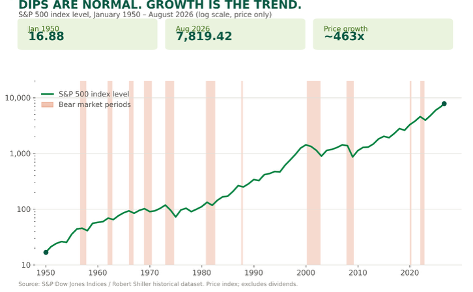
By February 19, despite a flurry of tariff announcements from the White House, most investors had decided to shrug off all the trade-war talk as not real. The S&P 500 reached 6,144, its second record high in two days, boosted by the hope that tariffs were more bark than bite.3

It would be the last one for a while.

Fast forward now to April 8. The S&P closed at 4,982, nearly 19% below its high on February 19.3 President Trump’s promise of “Liberation Day” tariffs, a broad and historically high slate of import duties on China, the European Union, and other countries, had so spooked investors that the S&P’s value had slid all the way back to where it had been a year prior.

Now investors had to wrestle with a new debate. Is this real? A real bear market, or just a correction? Are these tariffs permanent, or merely temporary? Everywhere you looked, there were headlines, videos, podcasts, and posts with different information, often with titles like “The Markets Are Just Like They Were in 19XX. Here’s What Experts Think You Should Do Next.” Or “The Last Time the Markets Did X, Y Happened.”

What was real? What was exaggerated? What was fake?

And now to our third date: December 26. On this day, the S&P 500 hit its most recent all-time high of 6,945.3(As of this writing, anyway. That number may be different by the time you read this.) The index later closed the day slightly lower, but for a moment, it was up a staggering 39% from where it landed on April 8.

What prompted this incredible turnaround? If we had to sum it up in a single sentence, it would be, “The normalization of things that previously caused uncertainty.” As many of the Liberation Day tariffs were canceled, suspended, or reduced, investors grew accustomed to the idea, emotions settled, and markets normalized. That enabled investors to turn their attention to other matters, such as falling interest rates and investments in AI by tech companies.

The result: 2025 was a fascinating and ultimately highly positive year for stocks.

But what was interesting about December 26 isn’t that the S&P hit an all-time high. That’s a common occurrence in a bull market. What was interesting is that gold also hit an all-time high on the very same day…something that hasn’t occurred since 1975.4 Gold is often used as a hedge against stock market volatility, so for both stocks and gold to hit record highs at the same time suggests many investors are feeling cautious about the future despite the stock market’s success. So, now the cycle begins again: What’s real and what isn’t? What’s signal and what’s noise?

All these questions are difficult enough. But modern investors also must contend with other distractions. You wouldn’t have to look hard, on any given day, to find hundreds of articles, videos, podcasts, and posts all designed to confuse you. “Invest in X/Don’t invest in Y.” “It’s time to buy/ It’s time to sell.” “Here’s what experts think you should know/Here’s what the experts don’t want you to know.” Some of this can be helpful…but much of it is slop, rage bait, or just plain wrong.

So, confronted with all this confusion, all this noise, what’s an investor to do? This, at last, brings us to what we think is the real theme of 2025. The most important lesson the year can teach us:

Success isn’t about constantly trying to detect what we think is fake.
It’s about valuing what we know is real.

What do we know to be real? For our clients, and we imagine for you, too, it’s the dreams and goals they’ve had for years. Those are far more real and significant than anything digital could ever be. By focusing on why we invest — for the places you want to see, skills you want to learn, milestones you want to reach, and the people you want to do it all with — we prioritize the meaningful over the distractive. Distractions like daily market movements or the bewildering deluge of slop and rage bait we get flooded with every day.

For our clients at Minich MacGregor Wealth Management, another is our investment process. A process far more tried and proven than trying to decipher headlines or wrestle with probabilities. By focusing on the process we know works, we can rely on the principles we know to be real… like diligence, patience, and discipline. That’s why our clients didn’t need to predict everything that would happen to have a successful year as investors. In 2025, we just needed to hold to our process.

And of course, there’s the most real thing of all: The people and relationships that bring true meaning to your life. There are so many voices on our phones, TVs, car radios, and social media feeds vying for our attention. But the more we tune them out and focus instead on the people who we know care about us, the more we fill our days with what’s genuine and authentic, the more everything that’s fake, frustrating, and unreliable gets filtered out. Slop, rage bait, it all just…fades away.

And that, to us, is why the real “word of the year” for 2025 isn’t slop, rage bait, or six-seven. It’s meaningfulness. For the more we hold to that word, the more we prioritize it in thought and deed, the more we will know that we are truly on the right path…to the life we were always meant to live.

So, that’s 2025! We hope it was a wonderful year. On behalf of our entire team, we look forward to making 2026 even better. As always, please let us know if you have any questions, or if we can ever help you and your family the way we help our client families. Have a Happy New Year!

1 “2025 Word of the Year: Slop,” Merriam-Webster, https://www.merriam-webster.com/wordplay/word-of-the-year
2 “2025’s Words of the Year, So Far,” Time, https://time.com/7334730/word-of-the-year-2025-cambridge-collins-dictionary-oxford-merriam/
3 “S&P 500 Historical Data,” Investing.com, https://www.investing.com/indices/us-spx-500-historical-data
4 “The S&P 500 and Gold Are at Record Highs,” Barrons, https://www.barrons.com/livecoverage/stock-market-today-122625/card/the-s-p-500-and-gold-are-at-record-highs-that-s-not-supposed-to-happen–Ras47ZC0A5FwZ556upxY

From Ancient Rome to Today: Happy New Year

The new year is coming up very quickly. We could talk about New Year’s resolutions or New Year’s Eve, but this year we want to tell you about the origins of New Year’s Day.

Did you know that the calendar year used to consist of just 10 months, consisting of 304 days? Back then, the New Year started on March 1. Romulus, the founder of Rome, created this calendar. In fact, the month of January didn’t even exist until about 700 B.C., which is when Numa Pontilius, the second Roman king, added January and February to the calendar. New Year’s Day was moved to January because this is when the new Roman consuls were elected. The new holiday took a while to catch on, as many people stuck to celebrating on March 1. Old habits …

New Year’s Day used to be dedicated to the Roman god Janus, from whom the month of January derives its name. This calendar was used until it fell out of sync with the sun. As a result, Julius Caesar decided to re-evaluate the calendar in 46 B.C. He worked with mathematicians and astronomers to determine what the new calendar should consist of, resulting in the Julian calendar, which is much like the Gregorian calendar currently in use. Caesar decided that the first day of the year would remain January 1st. He wanted to keep January the first month of the year since it was originally in honor of the Roman god Janus.

Back in medieval times, Christians replaced January 1 with days like December 25 and March 25 because New Year’s celebrations were considered pagan, but January 1 was officially reinstated as New Year’s Day in 1582. We suppose the thinking was that you don’t have to be in Rome to do as the Romans do.

That’s enough history to fill the next twelve months. From all of us here at Minich MacGregor Wealth Management, we wish you a Happy New Year! May you always stay in sync with the sun!

Sources:
http://en.wikipedia.org/wiki/Roman_calendar
http://www.history.com/topics/new-years
http://en.wikipedia.org/wiki/New_Year’s_Day
http://www.infoplease.com/spot/newyearhistory.html