Author: Minich MacGregor Wealth Management

Checklist

Q3 Financial Checklist

In 2004, a NASA pilot named David Oberhettinger was flying himself and two passengers toward Palm Springs in California.  Just as he was about to radio the nearest airport for permission to land, a “dense black smoke” began to fill his cockpit.1  It was immediately clear what was wrong: An electrical fire had broken out in his plane.

Nobody wants to panic at 8,000 feet above the ground.  Luckily, Oberhettinger kept his head and immediately swapped his Descent for Landing checklist for the In-Flight Electrical Fire checklist.  It listed five specific steps for averting disaster: (1) Master Switch to Off (2) Other Switches (Except Ignition) to Off (3) Close Vents/Cabin Air (4) Extinguish Fire (5) Ventilate Cabin.

As Oberhettinger later described it, completing the checklist “took maybe 90 seconds.” 1  The rest of the flight was a smooth, uneventful landing.  For Oberhettinger, the crisis “hardly caused a significant increase in heart rate, because I just followed the checklist.” 1 

There is a real power in checklists.  They can prevent us from panicking, or from having to rely on our memory more than we have to.  They prevent us from making the wrong decision at the worst time.  And while the checklists we create as financial advisors don’t usually involve the life-or-death drama of a pilot checklist, they are vital all the same.

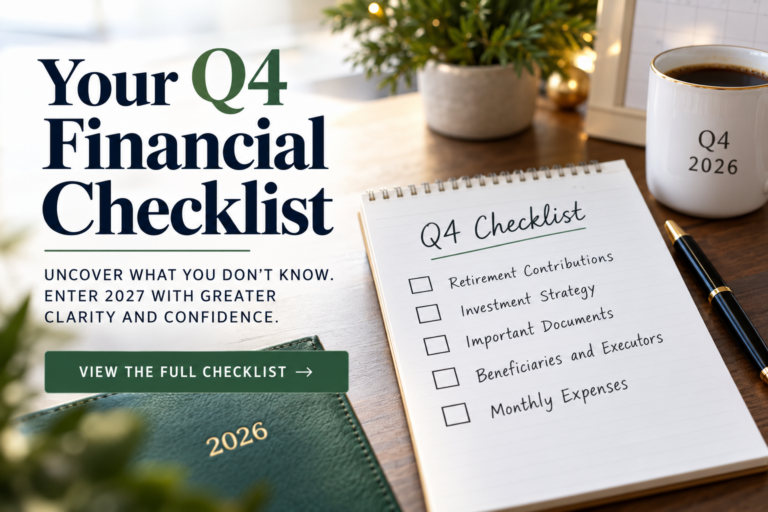
With that in mind, we’ve created a new checklist specifically for the third quarter of the year.  This checklist has six steps.  Don’t worry, they’re not difficult!  You may have handled some already.  Others may not even apply to you.  But each task is important in its own way.  Put them all together and you will be more likely to enjoy a smooth and uneventful flight towards your financial goals.  And while you won’t be able to complete the checklist in 90 seconds, 90 days should be more than ample.  As always, if you need help or have questions about any of these, please let me know.  In the meantime, we hope you have a great third quarter…and a wonderful summer!


Q3 Financial Checklist for 2024

Tip: Print this out and stick it on the fridge or somewhere else it will be seen.  That way, you can check off the items one by one as you complete them! 

  • Reprioritize Your Goals

    With the year now half over – where did the time go? – you may find that you have already accomplished some of the goals you set for yourself this year.  Others may be behind schedule; some may still just be words on paper.  That’s okay!  Working towards our goals should always be a marathon, not a sprint.  That makes this a good time to reprioritize your goals.  Do you have new goals that you didn’t have in January?  If so, write them down. Are there older objectives that need to be given more attention?  If so, determine where they need to be placed on your schedule.  By doing these things, you can ensure that the back half of 2024 is as productive and fruitful as possible. 

  •  Fund Your Child/Grandchild’s Education

    It’s summer vacation now, but Back-to-School season will be here before you know it.  If you have any children or grandchildren whom you want to ensure receive a higher education, use Q3 to either set up a new education funding account or contribute to one you already have.  From 529 Plans to Coverdell Education Savings Accounts, you have many options to choose from.  The key is choosing the right one for you, and then contributing to it consistently.  Please let us know if you need any guidance on this – we’d be happy to help!

  •  Check Your Credit Reports

    Credit reports aren’t just for getting loans – they’re a handy early-warning system for fraud and identity theft.  A good rule of thumb is to check your credit reports at least once per year.  If you haven’t checked yours yet in 2024, now is the best time to do so.  Be on the lookout for recent changes that don’t look familiar to you as well as “hard inquiries.”  This is when a business checks your credit report because they received a new application for credit or services.  These can impact your score and stay on your reports for two years or so.  They can also show you when people are trying to use your information illicitly. 

  •  Review Your Beneficiaries

    If you’ve had any major life changes – or if anyone in your family has – it’s a good idea to conduct a “beneficiary audit.”  Is everything still accurate and up to date?  If not, adjust your will and estate plan now so that your loved ones will always be taken care of, and your legacy ensured. 

  •  Pay Off Any Debts Incurred Earlier This Year

    It’s not uncommon to rack up debts during the first half of the year.  From vacations to home renovations to new purchases, it’s easier than ever to reach for the nearest credit card.  There’s nothing wrong with that – so long as those debts don’t linger and grow.  Pay them off now, if possible — or at least make a dent — so they don’t weigh you down as you work toward your long-term goals. 

  •  Evaluate Your Auto-Pay Bills

    Finally, if you’ve placed bills on autopay, be sure that the card or bank account the various companies have on file is correct.  Review whether certain bills have gone up, and whether there are less expensive options to consider.  And be sure to cancel any subscriptions you no longer need!


“Why do I love checklists? Because in 2004 a checklist helped avert what could have been some serious unpleasantness. And because rather than letting my imagination run amok to my detriment (otherwise known as “panicking”), effective use of checklists allow me to direct my imagination to more productive purposes.” 

— David Oberhettinger, former NASA Pilot and Chief Knowledge
Officer Emeritus at the Jet Propulsion Laboratory1

1 David Oberhettinger, “Why I Love Checklists,” NASA, appel.nasa.gov/2015/08/26/my-best-mistake-david-oberhettingers-why-i-love-checklists/

Whitehouse photo

Election Misconceptions

The noise can be deafening. It seems to come from everywhere, all the time. It can cause headaches, frustration, even anxiety. Sometimes, you wish you could turn it off altogether.

No, we’re not referring to whatever music the kids are listening to these days. We’re referring to the noise surrounding the upcoming presidential elections.

Election season is one of the most important aspects of our political system, but there’s no doubt that getting through it can be stressful. All of us, at some point, will wonder things like, “What if my preferred candidate doesn’t win?” “Who is my preferred candidate, anyway?” “Does so-and-so really mean this?” “Did so-and-so really say that?” “What’s fact and what’s fiction?”

One thing you shouldn’t have to worry about is how the elections will affect the markets. Every four years, many misconceptions arise about the impact of presidential contests on your portfolio. These often lead to unnecessary anxiety for investors. As financial advisors, our goal is to ensure our clients feel confident about their financial future, not worried. That’s why we send educational messages like this one. Let’s explore three common misconceptions about election season and the markets.

The first misconception is that presidential elections lead to down years in the markets. It’s understandable why we might feel this way. When we look back at past elections, the first things we remember are probably the controversies, uncertainties, and negativity. Election years feel volatile in our minds and memories, usually because there’s so much drama and so much at stake.

But statistics prove this misconception is a myth. Since 1944, there have been twenty presidential elections. In sixteen of those, the S&P 500 experienced a positive return for the year.1 In fact, the median return for presidential election years is 10.7%.1 Of the four election years that saw a negativereturn, two did occurin this century – in 2000 and 2008 – but on both occasions, the nation was either entering or in the midst of a significant recession.

Now, we do sometimes see increased volatility in the months leading up to an election. If we just look at how the S&P 500 performed from January through October in a presidential election year, the median return drops to 5.6%.1 That’s not bad, but it is nearly 50% lower. This suggests the uncertainty over who will triumph in the election – and the debate over what each candidate’s policies will mean for the economy – does tend to have at least some effect. Then, as the victor is announced and the picture becomes a little clearer, volatility tends to subside, and investors move on to other things. So, in that sense, election season does matter, but nowhere near what the media may have you believe. Elections are just one of the many ingredients in the gigantic stew that is the stock market…and they’re far from the most important.

The second misconception is that if one candidate wins, the markets will plummet. This narrative is, frankly, driven by pure partisanship. The fact of the matter is that the markets have soared under both Republican and Democratic presidents. Naturally, they’ve occasionally soured under both parties, too. Since 1944, the median return for the S&P 500 in the year after a presidential election is 9.8%.1 Since 1984? The median return rises to over 24%.

The reason for this is because of that gigantic stew we mentioned. You see, the markets are driven by the economy more than by elections. By the ebb and flow of trade, the law of supply and demand, by innovation and invention, by international conflict and consumer confidence. And while the president does have an influence on all this, it’s just one of many, many influences. As a result, the markets are far more likely to be affected by inflation and whether the Federal Reserve will cut interest rates than by the election.

When you think about it, the markets are like life. The course our lives take isn’t determined by one gigantic decision, but by the millions of small decisions we make every day. The same is true for the markets. We don’t know about you, but we find this comforting.

The third misconception is that we have no control over any of this, and thus, no control over what happens to our portfolio.

It’s true. We can’t dictate who the president will be. We can’t determine how the markets will react. But what we can control is what we will do. And that, is a mighty power indeed.

There’s a reason we began this email by referencing noise. As investors, one of the keys to long-term success is filtering out the noise and focusing on what reallymatters. You see, the goal of all political campaigns – and the media that covers them – is to create noise. That’s because noise provokes emotions. Fear. Anxiety. Anger. A greater emotional response leads to more clicks, more views, more shares, more engagement…and, yes, more money. It’s understandable why campaigns and the media want these things. But what we must guard against is letting those emotions drive our financial decisions. Emotions promote the urge to do something – buy, sell, get in, get out, take on more risk, less risk, you name it. They prompt us to make short-term decisions to alleviate what is, when you think about it, a short-term concern.

A presidential term lasts four years. But the goals you have saved for, and the time horizon you have planned for, lasts much longer than that. That’s why our investment strategy is built around the long-term. It’s designed to help you not just tomorrow, or next month, but years and years from now. It’s designed so that the president of the United States, as important as he or she may be, is only a passing mile-marker on the much longer road to your goals and dreams.

As we approach another election, keep this in mind: tune out the noise. Be aware of these misconceptions and avoid them. Our team is here to answer your questions and provide any assistance you need. If you’d like help planning for your financial future, give us a call. We’re always here to help.

Have a great summer!

1 “Election year market patterns,” ETRADE, us.etrade.com/knowledge/library/perspectives/daily-insights/election-stock-patterns