The Mother of the Valentine

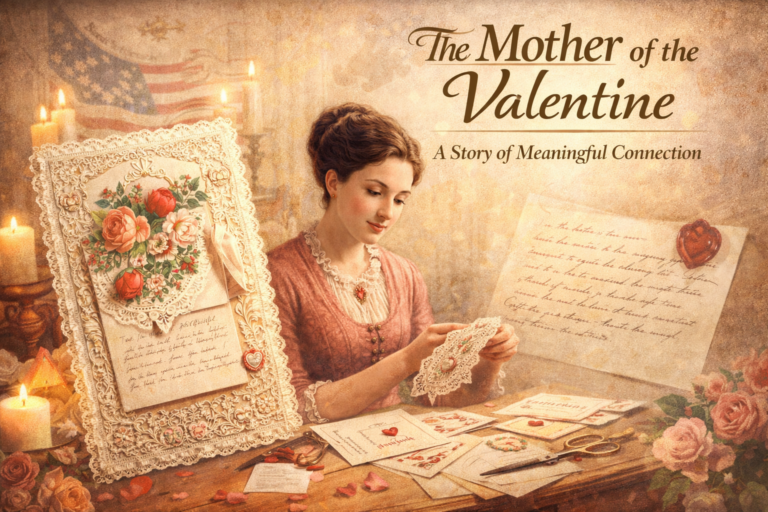
In 1847, a teenager named Esther Howland received something unusual in the mail: A letter pasted with colorful, hand-cut flowers and ringed by an elaborate border of lace. In the center was a small green envelope containing a tiny poem.
She had just received her first Valentine.
Esther was so impressed and excited, she shared it with all her friends and family. What’s more, she convinced her father — who owned a stationary store — to give her the materials she needed to make her own. But she didn’t stop at just one. With painstaking precision, she handcrafted a dozen colorful, ornate cards which she gave to her older brother in the hopes that he could sell them. Maybe, if she was lucky, she might receive $200 worth of orders.
Within a few weeks, she had made $5,000 selling valentines to people across Massachusetts.1
Soon, Esther was so busy filling out orders for more valentines that she enlisted all her friends to help. Together, they formed a kind of early assembly line. After Esther designed a prototype for each card, her friends would create multiple copies. Every girl had a job, whether it was cutting, pasting, coloring, embossing, or folding. Flowers, leaves, silk, satin, lace, vines, paintings, and even small mirrors were all used. Esther even developed some of the first “lift-up” flaps to appear on cards. The valentines weren’t just pretty to look at; they were tactile and interactive.
Esther’s business took off, capitalizing on what was already becoming a nationwide phenomenon. In 1849, the famous poet, Emily Dickinson, sent her cousin a letter on Valentine’s Day. It read:
The last week has been a merry one [here]in Amhert. Notes have flown around like snowflakes. [Even] ancient gentlemen and spinsters, forgetting time and multitude of years, have doffed their wrinkles in exchange for smiles. This aged world of ours has thrown away its staff and spectacles and now declares it will be young again.2
| The last week has been a merry one [here]in Amhert. Notes have flown around like snowflakes. [Even] ancient gentlemen and spinsters, forgetting time and multitude of years, have doffed their wrinkles in exchange for smiles. This aged world of ours has thrown away its staff and spectacles and now declares it will be young again.2 |
In 1853, one newspaper described what it was like to receive a valentine:
| There is the earnest fluttering of the pulses as the postman advances—hopes and fears alternately swaying the desires for a valentine, replete with tender expressions and soft inducements. The postman knocks—the face is flushed—the heart beats, and the beautiful missive, all decorated with hearts slung up in a halter, or pinned together with butchers’ skewers is opened. Who can paint a feeling? We will not try to do it.3 |
As the decades passed, Esther’s business flourished, and her valentines were seen all over the country until she finally retired in 1881 so she could spend more time with her ill father. By this time, companies were starting to produce simpler, mass-produced “machine cut” valentines, and eventually, Esther’s more elaborate, handmade designs faded into the past.
These days, it’s not uncommon to think cynically of Valentine cards, and of the holiday itself. But in Esther’s time, Valentine’s Day was one of the highlights of the year. That’s because it was a genuine chance to let someone know how much they truly mattered, in an era when it wasn’t always socially accepted or even physically possible to do so. And to receive a Valentine was to know that you were loved, cared for, or desired — feelings that allhumans have wanted since the beginning of time.
Some historians, in fact, believe that Valentine’s Day played a big role in changing how people thought about love. In a time when most people still married for economic reasons, Valentine’s Day helped create “a shift toward widespread acceptance of romantic love, especially as a basis for marriage.”2
These days, Valentine’s is often seen as an obligatory thing, the domain of big greeting card companies and chocolate conglomerates. But beneath all the advertising is something much simpler, more wholesome, and more real: Valentine’s Day is a chance to let the people in your life know what they mean to you, whether romantic or otherwise.
That’s how our team sees Valentine’s Day, anyway…and it’s why you’re reading this message. So, while we unfortunately do not have Esther Howland’s skill with arts and crafts, please see this as our valentine to you. We are all so grateful for the relationship we share with you, and for the opportunity to know and work with you. It’s something we cherish and take pride in every day.
Valentine’s is just the day we wanted to let you know it.
On behalf of everyone here at Minich MacGregor Wealth Management, we wish you a very happy Valentine’s Day!
1 “February 14, 1849: First American-Made Valentines Sold,” Mass Moments, www.massmoments.org/moment-details/first-american-made-valentines-sold.html
2 “Mother of the Valentine”: Esther Howland,” The American Antiquarian Society, https://pastispresent.org/2011/good-sources/%E2%80%9Cmother-of-the-valentine%E2%80%9D-esther-howland-worcester-and-the-american-valentine-industry/
3 “Touching Sentiment: The Tactility of Nineteenth-Century Valentines,” Common Place, www.commonplace.online/article/touching-sentiment/