Tag: finances

Ways to Cut Down on Your Gas Expenses

Due to the ongoing war in the Middle East, gas prices have risen sharply over the past month or so. Nobody wants to pay more at the pump, and even if the fighting ends quickly, it may take a lot longer for gas prices to return to normal.  (Economists often say that gas prices go up like a rocket when the price of oil rises but come back down like a feather even when the price of oil falls.)  For that reason, it’s never a bad idea to explore ways to save. 

To help, we’ve put together a few easy tips on how to increase your car’s fuel economy and pay less — or at least less often — at the pump.  

The Gas Tank

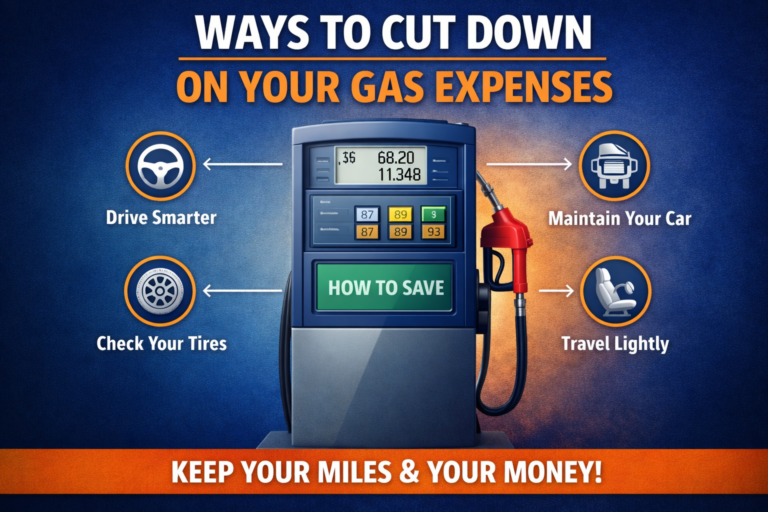
Making the right choice at the gas pump is an important first step to keeping your car running efficiently and economically.

Follow your owner’s manual recommendation for the right octane level for your car. For most cars, the recommended gas is regular octane. Using a higher-octane gas than the manufacturer recommends offers no benefit—and costs you more at the pump. Unless your engine is knocking, buying higher octane gas can be a waste of money.

Gas savings gadgets? Steer clear. Be skeptical about any gizmo that promises to improve your gas mileage. The Environmental Protection Agency (EPA) has tested over 100 supposed gas-saving devices—including “mixture enhancers” and fuel line magnets—and found that very few provided any fuel economy benefits.1 Those devices that did work provided only a slight improvement in gas mileage. In fact, some products may even damage your car’s engine or cause a substantial increase in exhaust emissions.

The Steering Wheel

When it comes to stretching your gas budget, how you drive can be almost as important as how far you drive.

Stay within the posted speed limits. Gas mileage decreases rapidly at speeds above 60 miles per hour.2 Avoid unnecessary idling. It uses as much as a half gallon of fuel per hour.2 Turn off the engine if you anticipate a wait. Avoid jackrabbit starts and stops. You can improve in-town gas mileage by driving smoothly and gently.  Use overdrive gears and cruise control when appropriate. They improve fuel economy when you’re driving on the highway.

The Tires

Keeping your tires properly inflated and aligned can increase gas mileage by up to 3% compared to when they are inflated at only 75% of the recommended pressure.3  As you can imagine, fuel economy decreases even further the lower your tire pressure goes. 

Under the Hood

You don’t have to be a gearhead to keep your engine purring at its fuel-efficient best.

Keep your engine tuned. Tuning your engine according to your owner’s manual and fixing more serious problems like faulty sensors can improve mileage by as much as 40%!2

Change your oil. Clean oil reduces wear caused by friction between moving parts and removes harmful substances from the engine. You can improve your gas mileage by using the grade of motor oil recommended in your owner’s manual and changing it according to the schedule recommended by your car manufacturer. Motor oil that says “Energy Conserving” on the performance symbol of the American Petroleum Institute contains friction-reducing additives that can improve fuel economy by 1.5-2.7%.4

The Driver’s Seat

The only sure-fire “equipment” guaranteed to get more from a gallon of gas is a fuel-conscious driver behind the wheel.

Combine errands. Several short trips taken from a cold start can use twice as much fuel as one trip covering the same distance when the engine is warm. 

Avoid keeping heavy items in your car.  An extra 100 pounds in your vehicle can increase gas costs by up to $0.3 cents per gallon.2  You can also reduce drag and improve efficiency by placing heavy items in the cab or trunk rather than on roof racks.  (The latter can decrease fuel economy by 8% in the city, and up to 25% on freeways.2

So, there you have it!  We hope you found these tips helpful.  Of course, higher gas prices are a small thing compared to the human cost of war, and we fervently hope this conflict ends soon.  But finding ways to save benefits everyone: Our families, our environment, and our economy.  So, if you have any of your own tips that we’ve missed, please share them with us so we can share them with others, too. 

1 “Gas Saving Products: Fact or Fuelishness?” FTC, https://www.govinfo.gov/content/pkg/GOVPUB-FT-PURL-LPS104499/pdf/GOVPUB-FT-PURL-LPS104499.pdf
2 “Fuel Economy,” U.S. Department of Energy, https://www.energy.gov/energysaver/fuel-economy
3 “Fact #983: Proper Tire Pressure Saves Fuel,” U.S. Department of Energy, https://www.energy.gov/cmei/vehicles/articles/fact-983-june-26-2017-proper-tire-pressure-saves-fuel
4 “Mastering the Basics: Lube Basics,” Motor Magazine, https://www.motor.com/magazine-summary/mastering-basics-lube-basics-november-2002/

4 Lessons from the Winter Olympics

Every four years, the world tunes in for the Winter Olympics, where some of the most memorable sporting moments in history have occurred. The “Miracle on Ice” in 1980, when an amateur U.S. hockey team defied the odds to beat the Soviet Union. The Jamaican bobsledders of 1988. Shaun White’s spectacular twists and flips on a snowboard in 2010. The list goes on.

The Winter Games are a showcase of some of the world’s greatest athletes, all demonstrating breathtaking skill and death-defying speed. But there’s something else that happens every four years. Something that occurs between the medal ceremonies and new records.

Crashes.

Skiers miss a turn and tumble down mountain slopes. Speed skaters collide and skid across the ice. Figure skaters slip and lose their balance as the crowd gasps and groans. In real time, we watch as people crash and fall…taking their dreams down with them. It’s as inevitable as it is frightful and regrettable. But it’s also, I think, the aspect of the Olympics that we can most learn from and be inspired by. Not the crash itself, of course…but what happens after.

While watching the Winter Olympics this past month, we realized that it’s in those moments that we can learn how to truly “go for the gold” in our own goals.

1. SUCCESS ISN’T ABOUT GETTING IT RIGHT THE FIRST TIME. IT’S ABOUT GETTING IT RIGHT OVER TIME.

At the 1988 Olympics, speedskater Dan Jansen’s path to a gold medal seemed a formality. But then, on the day of his race in the 500 meters, he received the worst possible news: His sister had died.

It’s no surprise, then, that Jansen fell on the very first turn. He didn’t win the gold. In fact, he didn’t even medal. Another fall occurred in a different event a few days later.

If this were a Hollywood movie, Jansen would have come back in ‘92 and won. He didn’t.

Finally, in 1994, aged twenty-nine and certainly in his final Olympics, Jansen stood on the podium with a gold medal around his neck… for the 1,000-meter event, the race nobody expected him to win. In his arms was his daughter, Jane, whom he named after his sister.

When we think about our financial goals, we always picture the end, when the deed is done, and victory is achieved. What we don’t often picture is the road to that goal. The false starts.

Dead ends. And yes, falls along the way. We could delay getting started. Make a bad investment. Lose our job. Our personal life might fall apart. Sometimes, we may end up going for the wrong goal and only arrive at the one that will truly make us happy much later in life. But the lesson from Dan Jansen and other athletes is that it’s okay. Success does not have to be immediate; the road does not have to be straight. So long as we keep showing up to the starting line every time, we will keep learning, improving, and growing. Achieving the goal itself is just a matter of time.

2. SOMETIMES, OUR FALLS ARE NOT AS BAD AS THEY SEEM.

Crashes, while less common in finance than on the slopes, can occur. It could be a stock market crash. It could be an unexpected event that forces us to empty our savings or take on debt. It could be a financial decision that blows up in our face. Whenever this happens, it’s easy to imagine that our present situation is ever-present. That the stock market will always be bad, that we will never get out of the red, that all our decisions go awry. That what is merely temporary is in fact permanent.

When this happens, it’s useful to remember the example of a remarkable Austrian skier named Hermann Maier. At the 1998 Olympics in Nagano, Japan, Maier was set to contend in several different events. But at his first event, tragedy struck. While competing in the downhill event, Maier flew right off the course, landed on his head, somersaulted several times, and crashed through two layers of safety netting. It was, in a word, horrific.

That’s how it looked, anyway. Incredibly, Maier was not only able to get up and walk away, but he also took gold in both the Super-G and Giant slalom events!

The lesson: crashes and falls are not always as bad as they seem. Nor are they always permanent. Markets recover and reach new heights. Savings accounts can be refilled; credit can be rebuilt. Most importantly, even a bad financial decision can end up being a net positive. That’s because…

3. EVERY SETBACK IS AN OPPORTUNITY TO LEARN.

In 2018, figure skater Nathan Chen was on top of the world. He was a superstar in the skating community, awing fans and competitors alike with his skill at quadruple jumps. When the Olympics began in South Korea, Chen was the sure favorite to win gold.

Yet on his first jump, he fell.

In fact, he made mistakes or lost his balance on every single jump in his routine, finishing fifth.

As he later described it, “[The] pressure really got to me. I felt as though this was my one and only chance. I felt such an urgency to be able to maximize this opportunity. I tended to gravitate towards things that I couldn’t control. The mistakes I made. I would gravitate towards anything I could have done better and sort of framed my mentality around that.”

Fast forward to 2022…to Nathan Chen standing on the winners’ podium, a gold medal around his neck. To Chen at a press conference, afterwards, where he was asked, “If he shook some demons from his Olympic past.”

“Rather than it being a demon,” he replied, “I think it was a helpful learning experience.”1

Chen had spent the four years between Olympics reflecting rather than self-criticizing. He realized he needed to reframe his thinking and change his relationship with competition. That he needed to enjoy the entire Olympic experience rather than worry solely about the result.

He learned from his mistakes, got up, and got better.

We can do this with our finances, too. After we make a bad investment, choose the wrong financial professional, or make a mistake with our taxes. After life throws a challenge at us that we didn’t expect or prepare for. We can treat those setbacks for what they are: Opportunities to learn. To become better investors. To enhance our knowledge and expertise. As Chen put it:

We’re all more resilient than we give ourselves credit for. You have to say, ‘Once you’ve become adapted to this new challenge, then you can handle any challenge of this same capacity again. [Think]: As I get through this, as I learn how to deal with this, if it ever happens again, I’m not going to be phased at all.’”1

4. THE GREATEST ACHIEVEMENT OF ALL IS MAKING THE DECISION TO TRY.

As financial advisors, we’ve helped so many people work toward a wide range of goals. And as rewarding as it is to see one of our clients retire early, succeed in their business, or finally take that trip they’ve always wanted, what really inspires us is the start of a client’s journey. When they dare to dream, when they have courage enough to try. Even if the path forward is new, scary, and filled with uncertainty.

Which brings us to the final story. One you’ve probably heard about, as it happened very recently.

The 2026 Winter Olympics were supposed to be the capper to Lindsey Vonn’s comeback story. After being riddled with injuries for much of her career, Vonn retired in 2019. But in 2024, she decided to make one final attempt for one final Olympic medal.

Then, just before the Games started, she tore a ligament in her knee. Despite this, Vonn decided to compete. So, when the first day of the downhill event began, Vonn was there at the starting line.  

We’ll let her describe what happened next:

“Yesterday, my Olympic dream did not finish the way I dreamt it would. It wasn’t a story book ending or a fairy tale, it was just life. I dared to dream and had worked so hard to achieve it. Because in Downhill ski racing the difference between a strategic line and a catastrophic injury can be as small as 5 inches. I was simply 5 inches too tight on my line when my right arm hooked inside of the gate, twisting me and resulted in my crash.

While yesterday did not end the way I had hoped, I have no regrets. Knowing I stood there having a chance to win was a victory in and of itself. We take risks in life. We dream. We love. We jump. And sometimes, we fall. Sometimes our hearts are broken. Sometimes we don’t achieve the dreams we know we could have. But that is also the beauty of life: We can try.

I tried. I dreamt. I jumped.

I hope if you take anything from my journey it’s that you all have the courage to dare greatly. Life is too short not to take chances on yourself. Because the only failure in life is not trying.”2

May we all have the courage to pursue our goals, even as the athletes on our screens pursue theirs. May we have patience with our progress and learn from our mistakes.

Most importantly, may we all have the resilience to get up after we fall.

1 “What’s it like to fall at the Olympics?” The Athletic, www.nytimes.com/athletic/7035806/2026/02/11/olympics-nathan-chen-figure-skating-fall/
2 “Lindsey Vonn confirms tibia fracture in crash,” The Athletic, www.nytimes.com/athletic/7034483/2026/02/09/lindsey-vonn-injury-update-fracture-olympics-post/