Tending a garden

Tariffs, Fear, and the Investor’s Dilemma: The Right Questions to Ask

The tariff-related questions that investors should be asking

“What should we do about tariffs?” It’s a question we’ve heard a lot lately, often with a note of fear in the voice of whoever is asking it. In this message, we want to answer that question. We also want to talk a little about fear, how we handle it…and how we can benefit from it.

If you’ve been following the financial news at all, you know that a feeling of anxiety has dominated the markets for the past month or so. But in the last few days, that anxiety has turned into fear. You see, on March 4, a 25% tariff on Canadian and Mexican imports went into effect.1 This requires U.S. companies that purchase goods from these countries to pay a 25% tax. At the same time, President Trump also imposed an additional 10% tariff on Chinese goods on top of the original 10% duty that began last month.1 As expected, all three countries have retaliated with their own tariffs on U.S. goods. That means the U.S. is now officially in a trade war.

The markets have not reacted to this news well. On March 4 alone, the Dow plunged over 600 points.2 The NASDAQ has been creeping closer to correction territory since late February.

When fear strikes, investors often start asking themselves the following questions:

Are the markets going into a correction?
Will the economy go into a recession?
Should I change my allocation?
Is it time to get out and move everything to cash?

You can probably hear them around the water cooler at work. You can see them online. They’re questions we frequently get from acquaintances of ours. But they are not the questions investors should be asking.

To be clear, tariffs — especially at these levels — are not a small thing. While they can be used to generate revenue or bring countries to the negotiating table, they also can increase business expenses and cut into corporate profits. When this happens, many companies will pass on these costs to regular people like you and me in the form of higher prices.

In other words, tariffs can be inflationary, at a time when we are still dealing with higher-than-normal inflation.

Investors know all this. What investors don’t know is how long these tariffs will last, how high they will go, or how big of an economic impact they will have. We don’t know whether they will trigger a major downturn in the markets. We can make reasonable assumptions and educated guesses, but we don’t know for sure. And that uncertainty, more than anything else, is why the markets have been so volatile lately. As the author H.P. Lovecraft once put it, “The oldest and strongest kind of fear is always the fear of the unknown.”

When fear grips the markets, many investors feel an intense urge to do something. After all, it seems so natural: When you know it might rain, you pack an umbrella. When you know you’ll have to drive in rush hour, you give yourself more time to reach your destination. As human beings, we always want to avoid the possibility of future pain. And since volatility can be painful, many investors start asking themselves: Should I change what I’m doing? Should I get out of the markets? The thinking is that if they can somehow avoid market turmoil, they can then get back in later when things are calm. Like skipping the freeway and taking service streets until you’re past the traffic jam.

But there’s a major problem with applying these metaphors to investing: They are short-term solutions for short-term problems. Investing, on the other hand, is for the long-term…and one of the biggest mistakes in investing is making a short-term decision that has long-term consequences. This is true in life as well. It’s why we pack an umbrella when it looks like rain, but we don’t move to another state. It’s why we may try to avoid driving when there’s heavy traffic, but we don’t sell our car.

That’s why a better metaphor for investing is planting a garden. With a garden, we don’t decide to uproot all our tomato plants and switch to squash after a month. We don’t put everything into pots because we hear distant thunder and know it might hail. We don’t overwater our plants just because we feel the need to constantly do something to help them grow. Instead, we choose the best possible soil. We plant with care. We water only when necessary. We harvest when things are ripe. And while we know the zucchinis might sometimes do better than the peppers, or the rosemary plant might fail, we always patiently give the seeds still in the ground all the time they need to sprout.

When volatility strikes, when fear and uncertainty dominate, we must always remember to treat our investments like a garden. Volatility, whatever the cause, is a short-term problem. Just as we want our garden to bear fruit for years, not months, it’s crucial that we make no short-term move that could harm our long-term plan.

Here’s how Peter Lynch, one of the most successful investors of all time, explains it: 

“A market calamity is different from a meteorological calamity. Since we’ve learned to take action to protect ourselves from snowstorms and hurricanes, it’s only natural that we would try to prepare ourselves for corrections. [But] far more money has been lost by investors preparing for corrections or trying to anticipate corrections than has been lost in corrections themselves. Skittish investors, fearing the correction is imminent, sell…their stocks and stock mutual funds. Or they put off buying stocks in companies they like and sit on their cash, waiting for the crash. But once the market reaches bottom, the cash sitters are likely to continue to sit on their cash. They’re waiting for further declines that never come, and they miss the rebound. They may still call themselves long-term investors, but they’re not. They’ve turned themselves into market timers, and unless their timing is very good, the market will run away from them.”3

For these reasons, here are the questions investors should be asking themselves:

  1. If I get out of the market now, how will I know when it’s time to get back in?
  2. Would I rather miss a correction that could last for a few months, or a rebound that could last for years?
  3. If I own investments I like, would I really want to sell them and risk buying them back at a higher price later?

To be clear, tariffs are an important story, and one that will quite possibly be with us for a long time. And market volatility is painful, make no mistake about that. But while we here at Minich MacGregor Wealth Management don’t welcome volatility, we don’t fear it, either. That’s because we know it’s an opportunity. An opportunity to be even more patient, even more disciplined, even more consistent than before. And it’s those qualities — patience, discipline, consistency — that make the most difference in the long run.

Blaise Pascal, the great mathematician and philosopher, once said, “All of humanity’s problems stem from man’s inability to sit quietly in a room alone.” We think there’s a lot of wisdom in that! So, while we will continue keeping a close eye on the markets — and while we will certainly send you more information in the future on tariffs and their effects — what matters most is this: We cannot do anything about tariffs, or how the markets react to them.

But we can do something about ourselves.

We can be gardeners.

So, as spring rolls in, as the flowers bloom and the trees begin to blossom, take this opportunity to focus on whatever garden you may grow at home. And know that as you do, our team is constantly tending the one you’ve entrusted us with. It’s a garden we intend to last a lifetime.

1 “Trump puts tariffs on thousands of goods from Canada and Mexico,” CNBC, https://www.nbcnews.com/politics/economics/trump-puts-tariffs-thousands-goods-canada-mexico-risking-higher-prices-rcna194542
2 “Dow tumbles again, loses more than 1,300 points in two days,” CNBC, https://www.cnbc.com/2025/03/03/stock-market-today-live-updates.html
3 “From the Archives: Fear of Crashing,” Worth.com, https://worth.com/from-the-archives-fear-of-crashing/

Scrollable
Types of Stock

Questions You Were Afraid to Ask #16

The only bad question is the one left unasked. That’s the premise behind many of our posts. Each covers a different investment-related question that many people have but are afraid to ask.

In recent posts, we’ve been breaking down some of the more common bits of financial jargon that you are likely to hear in the media about the stock market.  In this message, let’s look at: 

Questions You Were Afraid to Ask #16:
What do terms like blue-chip, value, and growth stocks mean?


If you ever tune into the financial media, you’re likely to encounter terms for different types of stocks.  Blue-chip is a frequent one; so are value and growth.  But what do these terms mean? 

Terms like these are a kind of shorthand description of a stock’s size, history, or risk profile.   With a single word, experienced investors can learn a lot about a company’s size, potential, and risks.  And since every investor has different goals to consider when selecting their investments, some may choose to focus on one type of stock over another.   

Let’s break down each term so you know what they mean if you ever hear them mentioned. 

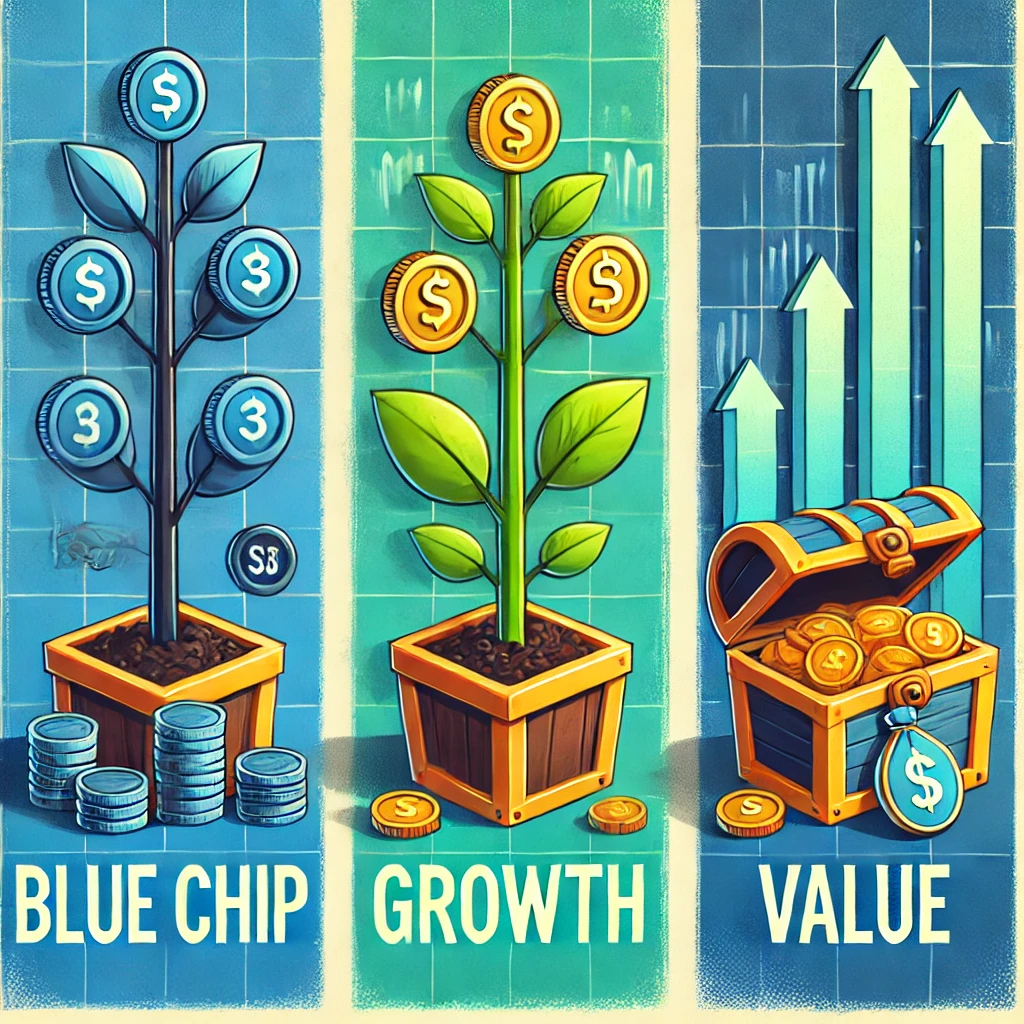
Blue-Chip Stocks. This term refers to stocks from large, financially stable companies with good reputations.  (The name comes from high-valued chips in poker, which are often blue in color.) 

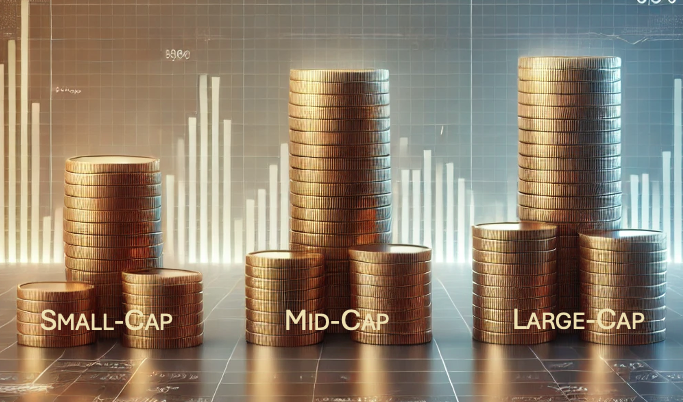
Typically, these companies have a sizeable market capitalization. (As you may remember from my last “Questions” letter, this is the total market value of a company’s available shares of stock.)  Blue-chip stocks are often household names that everyone would recognize.  If you look at the credit card in your wallet, the soda in your fridge, or the labels in your medicine cabinet, you will likely see examples of blue-chip companies. 

Investors often prefer blue chip stocks for a variety of reasons.  First, because these companies are well-established, they are often seen as less volatile.  While not guaranteed, blue chip companies tend to last for decades and can often weather recessions. 

Another reason many investors like blue chip companies is because they often pay regular dividends.  A dividend is when a company pays a percentage of their profits to shareholders, usually on a quarterly basis.  These dividends can either be reinvested or used as a source of income. 

Value Stocks. Imagine there were two fine dining restaurants in your area.  One is famous— the kind of place that gets mentioned in travel guides and where people go to propose.  The other, located a few blocks away, is a tiny spot that hardly anyone knows about.  But it tastes just as good as the touristy place, and best of all, it’s so much cheaper.  So, you decide to go there more often than not, aiming to enjoy it for as long as you can before the word gets out. 

Value stocks are similar.  The term refers to companies that appear to be undervalued — meaning they are trading at a lower price than they’re potentially worth.  Investors looking for value usually focus on companies with experienced leadership, steady revenue, a strong competitive advantage, and a low share price relative to their earnings.

Value stocks aren’t always easy to find, and the very concept of “value” is a subjective one.  But the idea is to find companies that could give you great bang for your buck and the potential for long-term growth.  Because, like that neighborhood restaurant, once the word gets out and the stock gets more popular, it could rise significantly in price. Of course, the risk of a value stock is that it could stay “undervalued” for a long time.

Growth Stocks. This term refers to stocks that have the potential to skyrocket in price over time.  Often, growth stocks are younger companies seeking to set new trends or shake up an industry.  These companies focus on growing rapidly and reinvest their earnings entirely into expansion.  Since technology is constantly changing, many investors look to up-and-coming tech companies for growth stocks, hoping to score the “next” Apple or Microsoft. 

But with this potential for growth comes the potential for more volatility.  Growth companies are often much riskier than value or blue-chip stocks, because they are younger, unproven, and have less stable finances.  For every growth company that succeeds and matures, there may be a handful that fail and disappear.

As you can see, each of these types have their own pros and cons. Blue chips tend to be reliable, stable, and often pay dividends — but they can be expensive and their potential for growth may be limited.  Value stocks have the potential to grow, and are typically not as risky as growth stocks, but may be hard to find.  Growth stocks could have the highest upside, but also the most risk and volatility.  For these reasons, many investors often seek to diversify by holding all three types, depending on their specific needs and goals. 

In our next post, we will look at a few other terms you’ll often hear in the media: Dividends, buybacks, and stock splits.  Until next time! 

Scrollable

MLK Memorial

Honoring Dr. King’s Legacy: Inspiring Words for Today and Every Day

Happy Martin Luther King Jr. Day!

Dr. King’s words have always been a source of inspiration to many. Even though they were written decades ago, they continue to resonate deeply and remind us of the power we all have to make the world a better place.

One of Dr. King’s most impactful writings, Letter from Birmingham Jail, was penned in 1963 while he was imprisoned for participating in nonviolent protests against segregation in Birmingham, Alabama. In the letter, King responds to criticisms from local clergymen who called his actions “unwise and untimely.” Rather than retreating, Dr. King used the opportunity to explain why he felt it was not only necessary but urgent to fight for justice. Though his words were shaped by the challenges of his time, they still hold incredible relevance today.

This year, as we honor Dr. King’s legacy, we took some time to revisit this powerful letter. It’s not an easy read. It’s a letter born of frustration, written in the face of incredible injustice. But it’s also a letter filled with hope, resilience, and a call to action that still rings true today.

There were a few quotes that stopped us in our tracks as we read, and we wanted to share them with you—not just for what they meant then, but for what they can mean to us now.

“Any law that uplifts human personality is just. Any law that degrades human personality is injust. Segregation…substitutes an “I it” relationship for an “I thou” relationship and ends up relegating persons to the status of things.”

This line reminded us of how easy it can be to lose sight of someone’s humanity. It’s something we see every day, whether in the rush of our busy lives or in moments of conflict and misunderstanding. Dr. King’s words challenge us to slow down, to really see the people around us—not just as roles or labels, but as individuals with their own stories, struggles, and dreams. Small acts of kindness, even something as simple as a smile or a kind word, can remind someone (and ourselves) of that shared humanity.

“Injustice anywhere is a threat to justice everywhere. Whatever affects one directly affects all indirectly.”

This is such a powerful reminder of how connected we are. When someone in our community is struggling, it isn’t just their burden—it’s something that ripples out and affects us all. But the same is true of hope and kindness. When we choose to lift each other up, those small actions can grow into something much bigger. They create a ripple effect that brings us all closer together and makes our communities stronger.

“So the question is not whether we will be extremists, but what kind of extremists we will be. Will we be extremists for hate or for love?  Will we be extremists for the perseveration of injustice or for the extension of justice?”

This quote makes us pause and reflect on the importance of taking a stand for our values. Dr. King wasn’t advocating for division or conflict; he was challenging us to think deeply about what matters most to us. It’s easy to stay neutral, to avoid uncomfortable conversations or hard decisions—but there are moments when silence isn’t an option. Whether it’s standing up for fairness, supporting a friend, or choosing kindness in the face of disagreement, we all have the power to leave a meaningful impact through the principles we choose to uphold.

As we reflect on these quotes, we’re struck by how relevant Dr. King’s words remain. They inspire us to approach the world with more compassion, to act with intention, and to believe that even small, everyday choices can make a difference.

On this Martin Luther King Jr. Day, we hope his teachings inspire you as much as they inspire us. Let’s honor his legacy by carrying forward his ideals—not just today, but every day. Let’s find ways to connect, to uplift, and to act with the courage and love he so powerfully demonstrated.

On behalf of everyone here at Minich MacGregor Wealth Management, we wish you a meaningful and reflective day. May Dr. King’s vision inspire us all to keep building a brighter future together.

Scrollable

2024 Year in Review image

2024 Year in Review: Lessons Learned & Navigating Uncertainty in Investing

Every January, we here at Minich MacGregor Wealth Management look back on the year that was. What were the highlights? What were the “lowlights”? What events will we remember? Most importantly, what did we learn? Then, we send a Year in Review message to our clients that encapsulates it all. We thought you might be interested in seeing it this year, too.

When we ponder the last twelve months, the theme of 2024, to us, is the importance of being able to operate under uncertainty. Here’s what we mean.

When the year began, there were several question marks hanging over the economy, the markets, and the nation as a whole. Each question mark, on its own, was important. Putting them all together made it extremely difficult for investors to know how the year would play out, which way the markets would go, or how the economic climate would evolve. In other words, there was a great deal of uncertainty. Let’s go through a few of the most important question marks one by one.

Which Way Will Inflation Go? The New Year kicked off with a positive outlook. Consumer prices had fallen significantly toward the end of 2023, and the expectation was that the trend would continue. But inflation rarely moves in a straight line. The inflation rate hovered around 3.1% in January, but by March, it was back to 3.5%.1  Inflation, it seemed, was still “sticky.”

This wasn’t pleasant news for the markets, because it dashed any hope that the Federal Reserve would cut interest rates in the spring. And the longer interest rates remained elevated, the more people worried about the possibility of a recession. As a result, the markets experienced a short-but-sharp dip in April.2 

Fortunately, the angst was short-lived. Over the next six months, inflation fell to 2.4% — the lowest since February of 2021, and awfully close to the Fed’s goal of 2%.1  That led to a long-awaited event in September, when we finally got some clarity on the second question mark:             

When Will Interest Rates Start to Come Down? Interest rates — the Fed’s primary tool for combatting inflation — began the year at 5.3%.3  That was the highest they’d been since early 2001. But while higher rates are effective at bringing prices down, the reason is because they cool down the economy. But if rates remain too high for too long, that coolant can ice over — and freeze the economy with it. Because of this, and because lower rates tend to juice the stock market, investors had been waiting with bated breath for any signs that rates were on the verge of coming down. Finally, in September, it happened: The Fed announced the first rate cut. Another one followed in October, and a third in November. By the end of the year, rates were down to 4.6%.3  That’s still historically elevated, but it’s a step in the right direction. That’s because we were also getting a positive answer to the third question mark:

Will the Economy Grow, or Slow? Predicting a recession has become something of a parlor game for economists. It’s not hard to understand why. Historically, raising rates to pull down inflation has almost always led to a recession. It’s called a hard landing, and it happens when prices come down so much that most businesses experience a major drop in revenue, causing them to lay off workers. Since unemployed people tend to spend less money, the economy contracts and enters a recession.

Despite years of dire predictions, this worst-case scenario never came true. Our gross domestic product, which measures our country’s total economic activity in a given period, grew by 1.6% in the first quarter, 3% in the second, and 3.1% in the third.4  As of this writing, we don’t have firm data for Q4 yet, but it’s estimated to be around the same.5 

Against all odds, for now, it seems we’ve achieved something rare: A soft landing.  

What About the Election? The fourth question mark was perhaps the least important as far as the markets were concerned, but it was also the one that got the most headlines: The November election.

Elections always create uncertainty, of course. Who will our next president be? What policies will they enact? How will they help or hurt my personal situation? History suggests that it doesn’t really matter which party controls Washington as far as the markets are concerned, but despite that, we do often see volatility leading up to the election itself. But that didn’t really happen this year. Other than a slight, brief dip at the very end of October, there was not a lot of volatility before the election, nor right after.6  Which brings us to our final question mark:

How Will the Markets React to All This? For investors, this was the biggest question mark of all. It’s always the biggest question mark of all. How would the markets react to the roller coaster of inflation? How would they react if it took longer for interest rates to drop? What about the election?

Well, now we know the answer to that, too. The S&P rose over 23% for 2024.7  When you couple that with the 24% gain we saw in 2023, it’s the best two-year performance in the index since 1997-98. The Dow, meanwhile, gained nearly 13%, and the NASDAQ over 28%.7   

Because we are looking back, because we know the answers to all these questions, it’s hard to remember the uncertainty that crept up at different points in the year. Nevertheless, uncertainty existed — and the investors who could handle it, benefited. The ones who could not, did not. We’re very happy to say that our clients belonged to the first group, but we know many people who didn’t.

Throughout the year, especially early on, we would often hear acquaintances of ours say things like, “I’m not getting into the markets until after the election.” Or “I’ll wait until interest rates come down to make a decision.” “Inflation is still too high for me, so I’ll think about it next year,” also popped up from time to time. In other words, many investors find it difficult to operate under uncertainty. Any question mark causes them to defer decisions and delay actions. Uncertainty can cause people to shut down, circle the wagons, and “turtle up.” As a result, two things happen:

  1. They miss out on the kind of year we just experienced in the markets.
  2. They don’t move forward to their financial goals.

Uncertainty is a fact of life, and as investors, we will always be dealing with question marks. Some years, there are more question marks than others, and that can certainly make things stressful. Of course, when we’re faced with uncertainty, it’s always good to slow down, take our time, and consider our options carefully. But it’s not good to become stagnant, hesitant, or fearful. It’s never good to procrastinate.  

Scientists have often held that one of the hallmarks of intelligence is the ability to make judgments under uncertainty. The ability to plan ahead even with limited information, and then adjust your plan as you learn. This is something that our team strives to do every day for our clients. We consider what we know and what we don’t. We try to identify possible outcomes and events, not to predict which will happen — which is impossible — but to prepare for as many as we can. From there, we determine what choices must be made now, which choices can be made now, and which should not be made now. Finally, we review the options that come with each choice, and which work best for each client based on their specific goals, needs, and situation.

It doesn’t mean everything will always go the way we want it to. It doesn’t mean we won’t occasionally experience setbacks. It does allow us to operate under uncertainty…which means we can always help our clients continue to work towards their dreams and financial goals.     

That’s what financial planning is all about. And that, to us, is the lesson to take from 2024.

Of course, there will be question marks in 2025, too. Here are just a few:

  • Is the inflation roller coaster truly over? Consumer prices ticked back to 2.6% in November, and there are some indications that they may rise higher still in the coming months.
  • President-elect Trump has promised to levy across-the-board tariffs against China and many other countries. What effect will those tariffs have on the economy, especially inflation?   
  • Will interest rates continue to fall, or will they remain where they are for a while? In its most recent statement, the Fed projected only two cuts for 2025.8 
  • Much of the market’s performance over the last two years has been generated by tech companies, especially those investing in AI. However, to date, many AI companies are valued far above what they are actually earning. Will that change in 2025? Will the hype continue?     

Here at Minich MacGregor Wealth Management, we’ll continue to study these issues…and even though you are not currently a client, we will update you as we get answers. But while there will always be question marks, we remain confident in our direction and in our ability to keep moving forward — whether the horizon is clear or blurry, the sky blue or gray.

So, that’s 2024! We hope it was a wonderful year. On behalf of our entire team, we look forward to making 2025 even better. As always, please let us know if you have any questions, or if we can ever help you and your family the way we help our client families. Have a Happy New Year!

Sources:
1 “12-month percentage change, Consumer Price Index,” U.S. Bureau of Labor Statistics, https://www.bls.gov/charts/consumer-price-index/consumer-price-index-by-category-line-chart.htm
2 “U.S. Equities April 2024,” S&P Dow Jones Indices, https://www.spglobal.com/spdji/en/documents/commentary/market-attributes-us-equities-202404.pdf
3 “Federal Funds Effective Rate,” Federal Reserve Bank of St. Louis, https://fred.stlouisfed.org/series/FEDFUNDS
4 “Gross Domestic Product,” U.S. Bureau of Economic Analysis, https://www.bea.gov/data/gdp/gross-domestic-product
5 “GDP Now,” Federal Reserve Banks of Atlanta, https://www.atlantafed.org/cqer/research/gdpnow/archives
6 “S&P 500 ends 5-month rally with October downturn,” S&P Global, https://www.spglobal.com/marketintelligence/en/news-insights/latest-news-headlines/s-p-500-ends-5-month-rally-with-october-downturn-86066097
7 “S&P 500 posts 23% gain for 2024,” CNBC, https://www.cnbc.com/2024/12/30/stock-market-today-live-updates.html
8 “Fed cuts key interest rate but signals elevated inflation is likely to persist,” https://www.nbcnews.com/business/economy/federal-reserve-interest-rate-cut-december-2024-much-economy-rcna184586

Scrollable

Honoring Our Heroes: A Heartfelt Thank You This Veterans Day

Most of us know somebody who’s served in the military or did so ourselves. For those who haven’t, it can be difficult to understand what it’s like to serve. It’s easy to forget the many sacrifices that our service men and women make. Hopefully, we all take the opportunity this Veterans Day to thank our soldiers, both past and present, for the courage they show(ed) in the face of the unimaginable. So, if you see a soldier, or someone who once was a soldier, please say:

Thank You.

Thank you for all that you do, and the sacrifices you’ve made. Thank you for leaving your friends and the comforts of home. Thank you for risking your lives, so that we can enjoy ours. Thanks for giving up the small moments in life: inside jokes, Super Bowls, backyard barbeques, and fishing trips. Thank you for allowing us to have our small victories, homecoming games, homeruns, touchdowns, dance recitals, first kisses, and first drinks. Thanks for giving us the opportunity to sleep soundly in our beds; to go to work and provide a life for our families.

Thank you for being dignified and respectful while representing our nation. Thank you for having your fellow soldiers’ backs; for suffering, bleeding, and in far too many cases, dying for our way of life. Thank you for being willing to endure cold nights, cold food, hard cots, and blisters. Thank you for coming home and doing your best to fit in, to not jump when a pot falls on the floor, or when the neighbors set off fireworks. Thank you for going through more than you thought possible. Thank you for your lost friends and comrades. Thank you for all the things we understand, and for everything we don’t.

Happy Veterans Day!

Scrollable