Three Things to Know About Midterms and the Markets

With elections just around the corner, a few clients have recently asked if we have any thoughts on the midterms and the markets. The answer is, of course, we do!
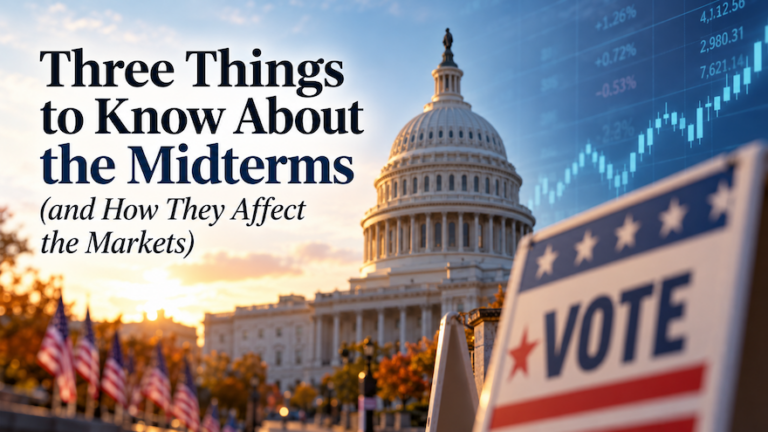
There are three things to know. First, midterm results don’t typically have a major impact on the markets. The second is that midterms themselves, however, often do.
The third, we’ll get to in a minute.
At first glance, #1 and 2 probably seem contradictory. But history — while not a guarantee of the future — paints a fairly clear picture. Between 1980 and 2025, the U.S. stock market has averaged a return of 8.7% in the twelve months before a midterm election…and 17.5% in the twelve months after.1 (If you move the starting date all the way back to 1900, those numbers change to 2.9% and 12.4%, respectively.) Outlier years, of course, can move these averages up or down, but this phenomenon has been fairly consistent.
This shows that midterms do affect the markets, as they tend to perform significantly better afterward.
But remember: The results of the midterms don’t have much of an effect. Statistically, the average 3-month return after the midterms has been 2.42% when one party controls both the White House and Congress, and 2.17% when control is divided between parties.1 This makes sense when you think about it. While both parties may bring vastly different policies to the table, dozens of factors dictate the markets. Politics are just one.
For this reason, it’s rarely worth worrying about how the midterms will play out for your investments. But that doesn’t mean we should ignore them entirely.
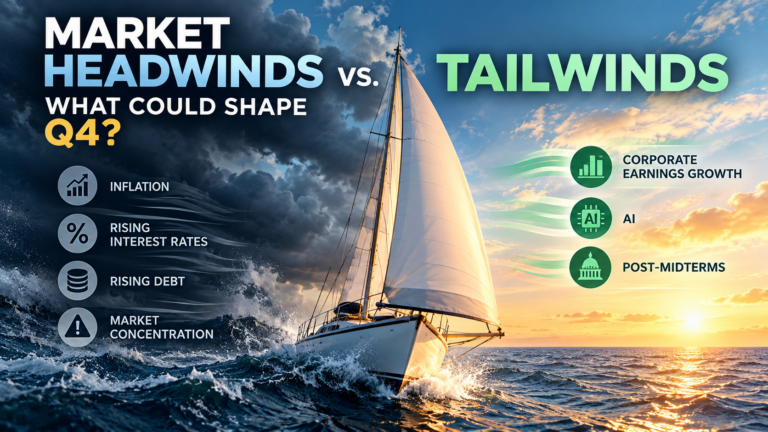
First, of course, is that “past results are not indicative of future performance.” (You know this already, but it’s always worth repeating. Just because the markets typically perform a certain way does not mean they always do.) And you never have to look hard to find potential for future volatility. There’s the fact that the majority of the stock market’s gains this year have been driven by only a handful of companies in a single industry — AI — leading to some concern among investors that we could be in an “AI bubble.” Furthermore, as of the end of September, 44% of the stocks in the S&P 500 were “down at least 20% from their 52-week highs.”2 In other words, nearly half of the S&P is in bear market territory. So, while the stock market’s gains in recent years have looked impressive on paper, our current bull market is a narrow one.
Second is the specter of stubborn inflation and rising interest rates, with the former feeding the latter. The latter can have a chilling effect on the economy, which in turn can affect the markets.
Third, history provides other averages for us to chew on besides what happens after the midterms. For example, there have been 56 market corrections (a drop of 10% or more from a recent peak) since 1929.3 This suggests they tend to happen, on average, every 1.7 years. The last correction took place in the spring of 2025. With certain metrics indicating that stock valuations (how much a stock is theoretically worth compared to what you pay to own it) are nearing all-time highs, it’s important to remember that corrections, while not necessarily common, are always possible.4
The long and short is that no one can guarantee how the next twelve months will go. History suggests a positive 2027. Recent storylines, however, provide plenty of reasons to be cautious.
But the main reason investors shouldn’t ignore the midterms is that they give us a chance to reflect on an important truth about investing. To illustrate, look again at those first two things to know: The midterms have a large effect on the markets, but not so much on the results. The question, then, is why? Why do markets tend to perform better after the midterms if the results don’t play that big a role?
This brings us to the third thing to know: The midterms matter to markets not because of politics, but because of uncertainty. Uncertainty over which party will be in power. Which policies will or will not be enacted. How it all will affect spending, taxation, regulation, and more.
Again, the results matter less than the transition from uncertainty to clarity.
You only need to scrutinize the hundreds of earnings calls that happen each quarter to see evidence of this. (Note: Don’t actually do this. You have better things to do with your time.) In an earnings call, the CEO or another high-ranking officer of a publicly traded company will report the corporation’s earnings for the quarter and provide guidance on what they expect to happen in the future. As the years have gone by, the number of mentions about uncertainty, elections, or politics on these calls has climbed.
Similarly, in a 2023 survey, CEOs ranked political uncertainty as the greatest risk to business growth.5 And in a survey from earlier this year, 43% of CEOs in the United States said uncertainty was the top threat their companies faced.6
It’s understandable why CEOs and investors would say this. That’s because uncertainty acts like a brake pedal. Think about driving your car in daylight in a place you know well versus driving in the dark in a place that’s unfamiliar. We’re willing to bet you drive much slower and more cautiously in the dark, or in a strange city. Your skill hasn’t changed, your car hasn’t changed, but your behavior changes. All because of uncertainty. The result? It takes longer to get where you’re going.
The same is true of the markets. During times of uncertainty, investors may slow down, stop, change directions, or even get out of the car entirely. Slower (or even negative) growth is the result. But when the road ahead looks clear, investors tend to rev the engine and put the pedal to the metal. Hence why the markets often do better after the midterms than before.
This is important to remember in the context of our own decision making. Think for a moment about decisions you have made in the past. Did you wait to make them until you felt certain of the outcome? Or did you ever choose the more cautious option because you were uncertain? Now think about the decisions you have to make in the future. These could be retirement-related decisions, or decisions about when to spend and when to save. They could be decisions about our insurance or our estate planning. With each, there will be times when we should wait for certainty, but also times when we must be prepared to act even when feeling unsure.
That’s why, as investors, it is so important to have rules, processes, and strategies that govern our decision-making. We will not always be able to wait until after an event passes to act. Nor will we always know the outcome of our decisions before we make them. At the end of the day, successful investing requires knowing ourselves more than knowing the future. Knowing what it is we trulyvalue. What kind of risks we are willing to take, and which ones we aren’t. Knowing which habits, behaviors, and commitments we must stick to over the long term to get what we want, even when short-term uncertainty may tempt us into abandoning them.
This is what’s truly important about events like the midterms. Not so much because of what they mean for the markets, but because of what they reveal about us.
Here at Minich MacGregor Wealth Management, we believe a well-designed financial plan and investment strategy should be built with uncertainty in mind. That’s why midterm elections and other short-term events don’t dictate our approach. While we monitor these developments closely, our focus remains on what matters most: you and your financial future. We believe you should always be in the driver’s seat, with your unique wants, needs, hopes, and dreams guiding the journey. Our role is to help you build a roadmap, navigate the inevitable twists and turns, and stay on course toward the life you envision.
As always, if you have any questions about the midterms or concerns about the markets, please let us know. We love to hear from you! In the meantime, have a great rest of your month, and enjoy the upcoming holiday season!
1 “How midterm elections affect the stock market,”www.usbank.com/investing/financial-perspectives/market-news/stock-market-performance-after-midterm-elections.html
2 “You might be shocked by how many stocks are in a bear market right now,” www.morningstar.com/news/marketwatch/2026092973/you-might-be-shocked-by-how-many-stocks-are-in-a-bear-market-right-now
3 “S&P 500 correction in six charts,”www.reuters.com/markets/wealth/sp-500-correction-six-charts-2025-03-13/
4 “This famed stock-market bubble indicator is broken,”www.businessinsider.com/stock-market-bubble-indicator-is-broken-shiller-cape-ratio-valuations-2026-8
5 “CEOs Say Political Uncertainty Poses Greatest Risk to Business Growth,” www.investopedia.com/political-instability-tops-ceos-future-fears-survey-finds-8348594
6 “Survey: CEOs Start 2026 on Edge, Citing Uncertainty as Top Threat,”www.conference-board.org/topics/c-suite-outlook/press/c-suite-outlook-2026