Q1 Market Recap

Whenever we look at history — and the first quarter is now exactly that — the temptation is always to simply recount what happened and leave it at that. It’s why many people could tell you, “Magna Carta was signed in 1215” or “Columbus sailed the ocean blue in 1492,” but they couldn’t tell you why it happened…or why it matters now.
The same temptation exists in the financial services industry. Right now, nearly every institution in the country is releasing its own “Q1 market recap.” Most will start like this: In Q1, the S&P 500 finished down 4.6% for the quarter. The Dow slid 3.6%, while the Nasdaq fell 7.1%.1
Many will go deeper, of course. They will say those numbers would have been lower had it not been for a strong rally on the very last day of the quarter. (The Dow rose 2.4% on March 31st, while the S&P 500 and Nasdaq jumped 2.9% and 3.8% respectively.1)
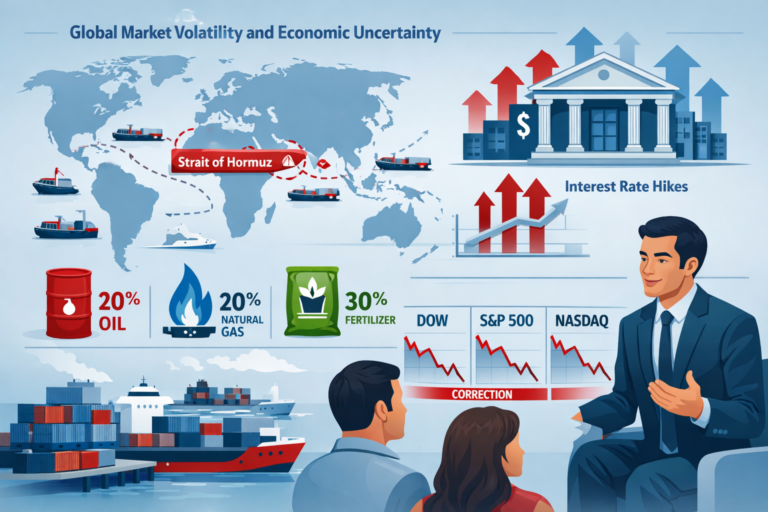
Some recaps will provide historical context for those numbers. They will say that these were all the biggest one-day gains the market has seen since May of 2025…but that the S&P and the Dow still had their worst quarter since 2022.1 In fact, the Dow and Nasdaq both briefly fell into “correction” territory, meaning a drop of 10% or more from a recent peak.
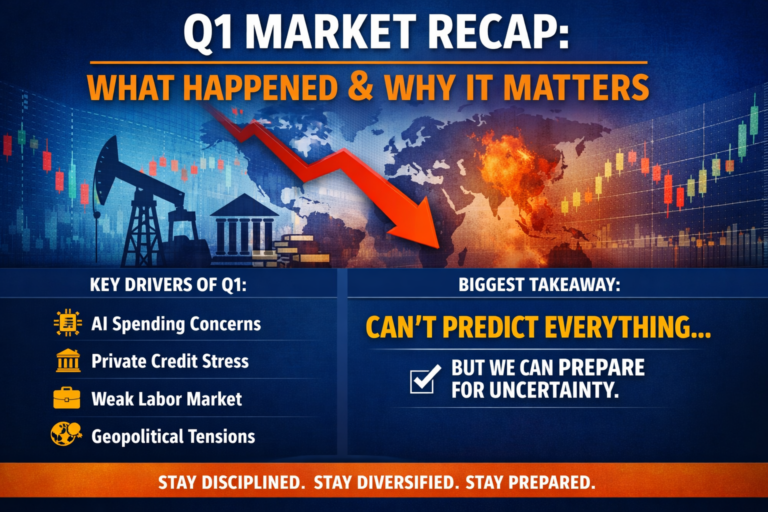
Good recaps will tell you the “why” behind these numbers. They’ll tell you that for the first two months of the quarter, the markets were down only slightly, stuck in a “one step forward, one step back” type of cycle. There were three main reasons for this: concerns about overspending on AI, private credit, and labor market doldrums.
A good recap should also tell you why these topics matter. For the last few years, enthusiasm over artificial intelligence has been the single biggest propellant for the markets. More specifically, it has driven some of the largest tech companies — think Alphabet (Google), Amazon, NVIDIA, and Tesla, among others — to historically high valuations, which has helped to lift the overall market. But the companies behind the AI boom are also spending incredible amounts of money, and most are not yet profitable. As the year began, investors expressed concern that it might be years before these companies made money, prompting many to cut back on their investments.
At the same time, investors all began to worry about the impact of AI. If artificial intelligence is truly all it’s made out to be, it could have several unintended consequences. For example, many AI tools can generate code, and thus, software, at a dramatically faster rate compared to traditional methods. That leads to the question: Why would anyone need to hire or work with a traditional software company in the future when they can just use AI?
Now, it’s still an open question whether AI truly can replace most software companies, but the fear is there…which caused investors to move away from some of those companies, bringing their stock prices down, too. But some investors can’t, which brings us to private credit.
Private credit is essentially “non-bank” lending. The private credit market, which has grown substantially in recent years, allows both institutions and individual investors to loan money to companies the way a bank normally would. Now, many private credit funds have lent to the same traditional software companies we mentioned earlier. Due to the fear that those companies might be going the way of the dinosaur, some investors have tried to withdraw their money. And since many of those funds have themselves received loans from banks, all this volatility has extended into the financial sector, whose performance was also a drag on the markets last quarter.
Finally, we have the issue of what AI means for jobs. Many in the tech industry claim that AI will eventually be able to do most of the white-collar jobs that exist today. Whether that’s true or not is a topic for another day, but there’s no doubt that some companies already believe it. In Q1 alone, some of the world’s biggest businesses replaced thousands of workers with AI, including Dow Chemical, HP, Oracle, and Amazon.2 That’s bad news for the labor market, which was already feeling the effects of slower economic growth. In February, for example, hiring fell to its lowest level in six years — when the pandemic was raging.3
All this takes us through the first months of the quarter. But here is where all those market recaps have to pivot to something nobody had prepared for. The single biggest reason why the markets ended the quarter in the red.
We’re talking, of course, about the war with Iran.
The conflict and the resulting surge in oil prices have renewed fears on Wall Street about elevated global inflation and higher interest rates. Typically, geopolitical events have a short-lived effect on the markets. But sometimes, conflicts can lead to economic disruption. When that happens, investors must contend with major uncertainty…and uncertainty means volatility.
And there is your Q1 Market Recap. You know what happened, why it mattered, and what the effects were. But while most recaps will end there, this one will not. Because to us, the real point of looking back at history, whether ancient or recent, isn’t just to recap what happened. It’s not even to figure out why it happened.
It’s to determine what lessons we can draw from it.
A few paragraphs up, we said nobody on Wall Street had prepared for a war in Iran. When the quarter began, it just wasn’t something on most investors’ list of things to worry about. With that in mind, we’ve been thinking a lot about the word “preparation” lately. It’s a strong-sounding word, isn’t it? To us, it’s a word that suggests maturity. Vigilance. Even wisdom. Throughout history, we doubt you’d find many people with bad things to say about preparation.
But what can we actually prepare for?
There are certainties in life that we know to prepare for. We know the sun will rise each day, so we prepare for tomorrow by laying out our clothes ahead of time. We know we will need to eat next week, so we do meal planning and buy the necessary ingredients in advance.
Of course, there’s plenty we can’t really prepare for. Nobody knows ahead of time when they will run over a nail and get a flat tire. Nobody knows ahead of time if this is the year the earthquake hits or the old tree finally topples over and lands on our garage. Nobody ever wakes up in the morning knowing that today’s the day they meet the person they will eventually marry. We simply can’t predict when these events will occur.
But we can prepare for possibilities. The possibility of getting into a car accident… which is why we wear our seatbelts each time we drive. The possibility of a natural disaster…which is why we buy insurance on our homes or ensure we have emergency food and funds. The possibility of meeting someone special…which is why we strive to look good, act well-mannered, and always put our best foot forward.
As investors, there are certain things that are difficult to prepare for. While we know conflicts can happen, they can still catch the markets completely by surprise. We know that an industry that propels the market forward can suddenly be the same one that drags it down, but we can rarely predict which and almost never predict when.
Many investors like to think they can predict events, or at least how the markets will react to them. Others spend a good deal of energy — and often, money — overreacting to everything they couldn’t predict. We are certainly starting to see that kind of behavior pick up again, just as we do in any volatile quarter. Which brings us to the single most important lesson of Q1:
The reason financial planning matters is that we can predict almost nothing; therefore, we cannot prepare for everything. But financial planning is about preparing for what we do know. And the more we do that, the less short-term surprises can affect our long-term progress to the things you care about most. We don’t know what will cause the next bout of market volatility, but we do know market volatility is inevitable. So, we can prepare for it by staying well-diversified and mentally disciplined. We don’t know when some unexpected life events will happen, but we do know about the life events you WANT to happen. (Like retirement!) We can prepare for them by ensuring your investments, savings, and spending are aligned with those events in mind. We don’t know what the markets will do tomorrow, what the government will do next month, or what the economy will do next quarter. But we do know what your taxes will probably look like, how much your family will need for college, and when it’s time to take Social Security… and that knowledge is far more powerful.
While Q1 was ultimately a “down” month for the markets, it served as an important reminder that while the future will always serve us surprises we cannot predict, it will rarely catch us unprepared. And when the future becomes the past, as all futures must inevitably do, we can look back…and in doing so, become even more prepared still.
As always, please let us know if you have any questions, concerns, or issues we can help with. In the meantime, have a great rest of your month…and a great second quarter!
1 “Wall Street soars as traders bet on potential war off-ramp,” Reuters, March 31, 2026. /www.reuters.com/business/wall-st-futures-rise-iran-war-de-escalation-hopes-indexes-set-monthly-drops-2026-03-31/
2 “More companies are pointing to AI as they lay off employees,” CBS News, February 27, 2026. www.cbsnews.com/news/ai-layoffs-2026-artificial-intelligence-amazon-pinterest/
3 “US job openings fall in February,” Reuters, March 31, 2026. www.reuters.com/business/us-job-openings-fall-february-hiring-lowest-since-pandemic-2026-03-31/