Lessons from Covid: How Global Disruptions Impact Your Investments

No, you are not reading a message that’s been stuck in our drafts since 2020. This message is about the world in 2026. But as you’ll see, the lessons we can apply today are drawn from the markets as they were exactly six years ago.
As you know, geopolitical conflicts tend to have a short-lived effect on the markets. But sometimes, conflicts can lead to economic disruption. When that happens, investors must contend with major uncertainty…and uncertainty means volatility. This is what we’re seeing now due to the ongoing war in Iran and the near-total closure of the Strait of Hormuz.
Disruption, uncertainty, and volatility.
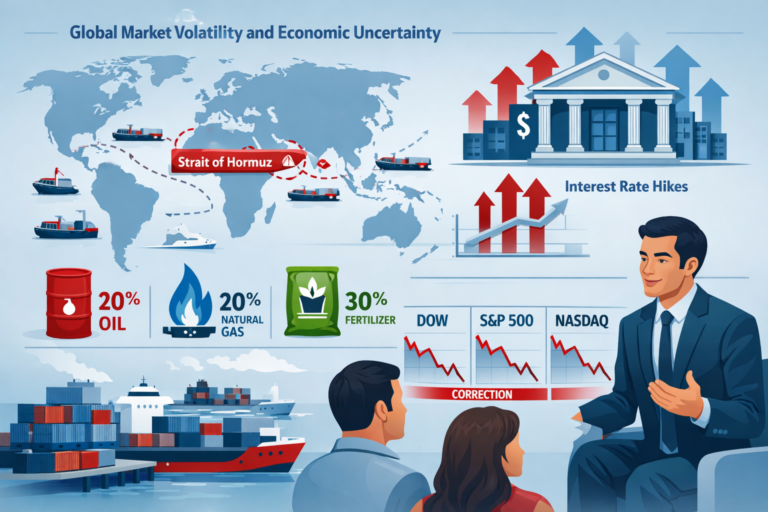
Here’s the situation in a nutshell: 20% of the world’s oil flows through the Strait.1 With only a few tankers passing through over the last few weeks, the world is facing the single largest supply disruption in history, made worse by the fact that Iran has also struck nearby oil and gas facilities across the Persian Gulf. Due to this, the price of oil has risen to over $100 a barrel, with Brent crude, the global benchmark, rising as high as $113.1
Oil, as you know, is the blood that powers the world economy. Furthermore, it’s not just oil that passes through the Strait. In fact, up to 20% of the world’s natural gas and 30% of its fertilizer transported by ship must first transit the Strait before reaching the wider ocean.2
Take a moment to visualize what this looks like. Three products, oil, gas, and fertilizer, all choked off in one of the world’s most important pipelines. Over the coming weeks, ships that have already left the Strait will finish delivering what supplies they have, but after that, shortages may begin.
Now, the United States does not heavily rely on oil and gas passing through the Strait, as we have our own supply of both. But Asia and Australia do, which means that goods produced on these continents may become much more expensive. Natural gas is a critical part of producing fertilizer; fertilizer is a critical part of growing food. Both gas and oil are used to produce plastic, which is used to contain nearly everything that gets shipped from one place to another. Shipping, of course, requires oil.
Some countries that normally depend on oil and gas from the Persian Gulf can potentially pivot to other forms of energy. China and India, for example, have enormous coal reserves. But not all countries can do this, and even those that can, probably won’t be able to replace all of what they normally get from the Strait. Furthermore, pivots take time. As a result, many countries simply may not be able to produce the amount of goods they normally do. And as we know from the Law of Supply and Demand, when supply goes down but demand does not, prices rise. Not just for oil and gas, but for everything that is made or transported by oil and gas.
Here is where the lessons of the Covid years begin to kick in, because we’ve seen something like this before. When supply chains get disrupted, as they were during the Covid shutdowns of 2020, prices rise. We call this inflation.
When the price of goods rises, something else tends to rise with it: The cost of money itself. By this, we’re referring to interest rates. Here in the United States, the Federal Reserve, which is mandated to keep prices stable, typically fights inflation by raising interest rates. (Investors learned all about this after 2020, too.) Higher interest rates make it more expensive to borrow money, which in turn tamps down on spending. Lower spending, in turn, forces businesses to reduce their prices, thereby reducing inflation.
As of this writing, the Fed has not raised the Federal Funds Rate, which is the key interest rate that our central bank controls. But this isn’t the only interest rate that matters. One rate that has jumped in recent weeks is that of the 10-year Treasury Note.3 This interest rate — which is essentially the rate at which the government borrows from investors for a term of 10 years — influences mortgage rates, credit cards, and other types of loans. The fact that it’s on the rise is the market’s way of saying that investors expect interest rates in general to rise, too.
Put all these factors together and you suddenly have a situation that looks a bit like the Covid-era. There are some important differences, of course. For one thing, oil prices initially plummeted during the Covid shutdowns. And it was the combination of snarled supply chains plus a major surge in demand after the world reopened that triggered inflation. But the potential trio of economic disruption, rising inflation, and higher interest rates is doing the same thing it did all those years ago: Inject significant uncertainty into the markets.
Which is why the Dow, the S&P 500, and the Nasdaq are all in “market correction” territory.4 (A correction, remember, is a drop of 10% or more from a recent high.)
Now, note that we used the word “potential” just a moment ago. That’s because we’re still in hypothetical territory here. We don’t yet know exactly whether and how much inflation will go up, or for how long, or what that will mean for interest rates over the long-term. We certainly can’t predict what the markets will do. Corrections are common, and it’s possible the war could end as quickly as it started.
But there are two major mistakes an investor can make whenever uncertainty kicks in. The first is to bury our heads in the sand and pretend everything is fine. As you can see from all the analysis you just read, we are certainly not going to make that mistake here at Minich MacGregor Wealth Management. Because there’s no point in sugarcoating it: This situation has major ramifications for the global economy. And even if the war were to end tomorrow, that doesn’t guarantee everything will go back to normal overnight. Oil prices alone may remain elevated for some time. (There’s a saying among economists that oil prices rise like a rocket and fall like a feather.)
The second mistake is to take that uncertainty and think the sky is falling. And here is where the major lessons from Covid come into play.
Over the coming days and weeks, we may see plenty of headlines that point out just how serious the situation is. We might see words like “unprecedented” or “historic.” Terms like “correction,” “downturn,” or even “bear market” could be on the cards, too. But if that happens, remember this: We’ve been through this before. And we’ve made it through this before, too.
Close your eyes and think back to how much uncertainty existed in the spring of 2020. We can still remember where we were when we heard the news about quarantines and shelter-in-place restrictions. We can still remember how the schools closed, and “non-essential” offices closed, and grocery store shelves got frighteningly bare. And we can remember how the markets reacted to it all. We’re sure you can, too.
We can also recall what happened next. How the markets stabilized, rebounded, and expanded.
Covid taught us that patience, steadiness, and the ability to look past immediate headlines become more important during times of increased uncertainty, not less. Because while uncertainty creates volatility, it also creates opportunity. Opportunities for companies to adapt, and in adapting, find new ways to grow. Opportunities for the markets to rebound, and in rebounding, reach new heights. It’s not easy to endure the volatility to get to the opportunity. It never is. But the one thing we know for sure is that we do not want to be absent when opportunity comes.
The pandemic was a historic event that had major ramifications for the global economy. It’s possible that what’s happening in Iran will be, too. We don’t know how long it will last, or how deep its impacts will be. But even historic events eventually become just that: History.
One day, we expect we’ll write a message titled, “Lessons from Iran,” too.
The final lesson that we hope all our clients learned during Covid, is that our team will always be here for you. Whether the current volatility resolves or increases, we are always available to answer your questions, address your concerns, and examine every development. So, if you would ever like to talk — about Iran, about your portfolio, or anything else — please reach out. We always love to hear from you!
1 “A new oil shock is building,” CNBC, https://www.cnbc.com/2026/03/28/oil-gas-prices-iran-war-hormuz.html
2 “It’s not just oil. Here comes Hormuz inflation.” Politico, https://www.politico.com/news/2026/03/14/hormuz-inflation-helium-fertilizer-00828680
3 “Treasury yields rise as Iran ceasefire optimism fades,” CNBC, https://www.cnbc.com/2026/03/26/treasury-yields-rise-uncertainty-ceasefire-talks.html
4 “Dow closes in correction,” CNN, http://cnn.com/2026/03/27/investing/us-stocks-iran