Election Misconceptions

The noise can be deafening. It seems to come from everywhere, all the time. It can cause headaches, frustration, even anxiety. Sometimes, you wish you could turn it off altogether.

No, we’re not referring to whatever music the kids are listening to these days. We’re referring to the noise surrounding the upcoming presidential elections.

Election season is one of the most important aspects of our political system, but there’s no doubt that getting through it can be stressful. All of us, at some point, will wonder things like, “What if my preferred candidate doesn’t win?” “Who is my preferred candidate, anyway?” “Does so-and-so really mean this?” “Did so-and-so really say that?” “What’s fact and what’s fiction?”

One thing you shouldn’t have to worry about is how the elections will affect the markets. Every four years, many misconceptions arise about the impact of presidential contests on your portfolio. These often lead to unnecessary anxiety for investors. As financial advisors, our goal is to ensure our clients feel confident about their financial future, not worried. That’s why we send educational messages like this one. Let’s explore three common misconceptions about election season and the markets.

The first misconception is that presidential elections lead to down years in the markets. It’s understandable why we might feel this way. When we look back at past elections, the first things we remember are probably the controversies, uncertainties, and negativity. Election years feel volatile in our minds and memories, usually because there’s so much drama and so much at stake.

But statistics prove this misconception is a myth. Since 1944, there have been twenty presidential elections. In sixteen of those, the S&P 500 experienced a positive return for the year.1 In fact, the median return for presidential election years is 10.7%.1 Of the four election years that saw a negativereturn, two did occurin this century – in 2000 and 2008 – but on both occasions, the nation was either entering or in the midst of a significant recession.

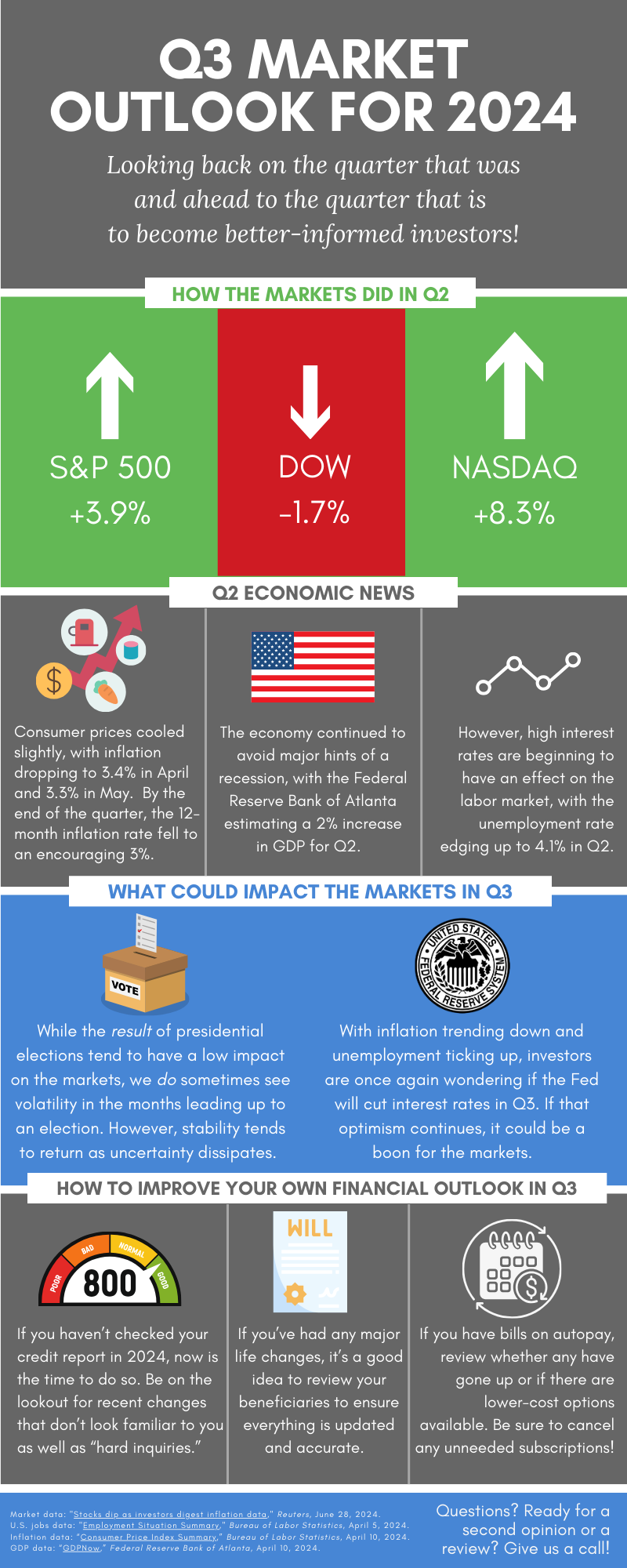
Now, we do sometimes see increased volatility in the months leading up to an election. If we just look at how the S&P 500 performed from January through October in a presidential election year, the median return drops to 5.6%.1 That’s not bad, but it is nearly 50% lower. This suggests the uncertainty over who will triumph in the election – and the debate over what each candidate’s policies will mean for the economy – does tend to have at least some effect. Then, as the victor is announced and the picture becomes a little clearer, volatility tends to subside, and investors move on to other things. So, in that sense, election season does matter, but nowhere near what the media may have you believe. Elections are just one of the many ingredients in the gigantic stew that is the stock market…and they’re far from the most important.

The second misconception is that if one candidate wins, the markets will plummet. This narrative is, frankly, driven by pure partisanship. The fact of the matter is that the markets have soared under both Republican and Democratic presidents. Naturally, they’ve occasionally soured under both parties, too. Since 1944, the median return for the S&P 500 in the year after a presidential election is 9.8%.1 Since 1984? The median return rises to over 24%.

The reason for this is because of that gigantic stew we mentioned. You see, the markets are driven by the economy more than by elections. By the ebb and flow of trade, the law of supply and demand, by innovation and invention, by international conflict and consumer confidence. And while the president does have an influence on all this, it’s just one of many, many influences. As a result, the markets are far more likely to be affected by inflation and whether the Federal Reserve will cut interest rates than by the election.

When you think about it, the markets are like life. The course our lives take isn’t determined by one gigantic decision, but by the millions of small decisions we make every day. The same is true for the markets. We don’t know about you, but we find this comforting.

The third misconception is that we have no control over any of this, and thus, no control over what happens to our portfolio.

It’s true. We can’t dictate who the president will be. We can’t determine how the markets will react. But what we can control is what we will do. And that, is a mighty power indeed.

There’s a reason we began this email by referencing noise. As investors, one of the keys to long-term success is filtering out the noise and focusing on what reallymatters. You see, the goal of all political campaigns – and the media that covers them – is to create noise. That’s because noise provokes emotions. Fear. Anxiety. Anger. A greater emotional response leads to more clicks, more views, more shares, more engagement…and, yes, more money. It’s understandable why campaigns and the media want these things. But what we must guard against is letting those emotions drive our financial decisions. Emotions promote the urge to do something – buy, sell, get in, get out, take on more risk, less risk, you name it. They prompt us to make short-term decisions to alleviate what is, when you think about it, a short-term concern.

A presidential term lasts four years. But the goals you have saved for, and the time horizon you have planned for, lasts much longer than that. That’s why our investment strategy is built around the long-term. It’s designed to help you not just tomorrow, or next month, but years and years from now. It’s designed so that the president of the United States, as important as he or she may be, is only a passing mile-marker on the much longer road to your goals and dreams.

As we approach another election, keep this in mind: tune out the noise. Be aware of these misconceptions and avoid them. Our team is here to answer your questions and provide any assistance you need. If you’d like help planning for your financial future, give us a call. We’re always here to help.

Have a great summer!

1 “Election year market patterns,” ETRADE, us.etrade.com/knowledge/library/perspectives/daily-insights/election-stock-patterns

5 Financial Regrets

This is about common financial regrets. It lists five specific regrets that many people have, three of which were found to be especially common in a recent Forbes study. The infographic also covers how to avoid these regrets, and we you can help.

Questions You Were Afraid to Ask #13

The only bad question is the one left unasked. That’s the premise behind many of our recent posts. Each covers a different investment-related question that many people have but are afraid to ask. In our last post, we discussed what it means to invest in commodities and how regular investors do so. So, without further ado, let’s break down:

Questions You Were Afraid to Ask #13:
What are the pros and cons of investing in commodities?


As we covered in Question #12, a commodity is a physical product that is either consumed or used to produce something else. For example, corn, sugar, and cotton are all agricultural commodities. Pork, poultry, and cattle are livestock commodities. Oil, gas, and precious metals like gold and silver are commodities, too.

A commodity is generally seen as an alternative investment. Traditionally, large institutions and professional traders are the most likely to invest in commodities, but regular people can, too. Like every type of investment, though, there are both potential benefits and risks that come with commodities. Some of these are very specific to commodities.

First, let’s look at some of the pros of investing in commodities:

Diversification. As you know, all types of investments will rise and fall in value at different times. That’s why it’s important that your portfolio consists of diverse asset classes, each driven by different factors. (Financial advisors like us refer to this as having low correlation, meaning price changes in one asset don’t affect the price of another asset.)

Typically, commodities have a low correlation to stocks and bonds. Every type of commodity is affected by different economic factors. Most of those don’t usually affect, say, stocks. For example, while changing interest rates can have a major impact on stocks, they don’t have a direct effect on cotton prices. And though a hurricane in the Gulf of Mexico can dramatically impact oil prices, it usually doesn’t mean much to the overall stock market.

For these reasons, investing in commodities can add valuable diversification to your portfolio.

Diversification is important because it can help cushion your portfolio from major volatility. If one asset class takes a hit, the others could help compensate. However, it is important to note that diversification doesn’t eliminate risk.

Hedge Against Inflation. During periods of high inflation, the price of most consumer goods and services will go up. While that can make for an unpleasant-looking receipt at the grocery store, it can be a boon to commodity investors. That’s because the price of many commodities tends to go up with inflation. As a result, investing in commodities can help “hedge” – or lessen – the risk of investing in other asset classes that may be negatively affected by inflation.

Potential for Significant Returns. Commodities can also – potentially – produce meaningful returns. Certain types of commodities will occasionally rise drastically in demand, taking their price up with them. As a result, investing in the right commodity at the right time can certainly help investors generate a significant profit!

Of course, that same potential is also behind some of the downsides to investing in commodities:

Volatility. Commodities can be extremely volatile. As you’ve no doubt seen, the price of any commodity (say, oil, or gold) can fall remarkably fast if the demand for those products falls far below their supply. For these reasons, you should only invest in commodities if you can afford to take on the…

Multiple Risks. As we mentioned, all types of investments come with risks. However, the risks associated with commodities are particularly large and varied. For example, some commodities – especially agricultural ones – are vulnerable to weather. Others can be affected by natural disasters, military conflicts, or changing government regulations. While these same factors can certainly drive prices up, they are also just as likely to drag prices down if the wrong conditions arise. Furthermore, investors have no control over these types of risks…and they are notoriously difficult to predict in advance.

No Income. Finally, commodities do not produce any income for investors the way bonds or dividend-paying stocks do. So, investors seekingincome – especially retirees – may find that the pros of commodities are just not worth the risks when it comes to fulfilling their needs.

In the end, there’s simply no “one size fits all” type of investment, and that’s especially true of commodities. While they can be a viable fit for some portfolios, every investor must look carefully at whether commodities are right for their needs, and whether the risks associated with them are more than they can afford.

So, now you know the “how” and the “why” of investing in commodities. In our next few posts, we’re going to demystify common investment–related jargon you may hear bandied about by the media. In the meantime, have a great month!

Questions You Were Afraid to Ask #12

The only bad question is the one left unasked. That’s the premise behind many of our recent posts. Each covers a different investment-related question that many people have but are afraid to ask. In this post, let’s cover a specific type of investment that people often wonder about:

Questions You Were Afraid to Ask #12:
What does it mean to invest in commodities?


In an investing context, a commodity is a physical product that is either consumed or used to produce something else. For example, corn, sugar, and cotton are all commodities. We generally refer to products like these as agricultural commodities. Pork, poultry, and cattle are livestock commodities. Energy products, like oil and gas, are commodities, too. So are precious metals like gold, silver, and platinum.

A commodity is generally seen as an alternative investment. Alternative investments are called that because they trade less conventionally than more traditional stocks and bonds. Despite this, many people find the idea of investing in commodities to be an attractive one. For some, it’s because it makes more intuitive sense than owning shares in a company (buying stock) or lending money to an organization (buying bonds). There’s something tangible about the idea of investing in things we see and use daily. By comparison, stocks and bonds can feel a little more abstract. For others, investing in commodities is a way of adding even more diversification to a portfolio.

That said, the question of how to invest in commodities can be an overwhelming one. Most people – including experienced investors – don’t even know how to get started! So, let’s discuss some of the potential ways to invest in commodities. Then, in our next post, we’ll cover some of the pros and cons of this particular asset class.

The oldest and most basic way to invest in commodities is to physically own them. This is what traders have been doing for most of human history. Person A buys a herd of cattle from Person B, and then sells some or all of them to Person C, hopefully for a profit. Person X buys a stack of gold bars from Person Y and then sells them to Person Z. You get the idea.

This, of course, is still done today. But for most retail investors – regular folks like you and me – taking physical ownership just isn’t feasible. When you buy commodities, you must also have a way to store them. Unlike stocks and bonds, commodities take up space… usually a lot of it! You must also have a way to deliver the commodities to and fro. You’d also want to purchase insurance on the product in case something went wrong. And of course, you would need to have a lot of technical expertise to know how to trade those commodities for a fair price.

For these reasons, most investors choose one of two avenues: Buying stock in companies that produce commodities or by investing in commodity-based funds. Let’s start with the first.

Let’s say you wanted to invest in a certain type of precious metal that you feel will rise in value in the future. Obviously, for reasons we’ve already covered, you don’t want to own the metal itself. So, instead, you buy stock in a company that specializes in mining or extracting that particular metal. Should the price of that metal go up, it’s quite possible that the stock price for the company that specializes in that metal will go up, too.

Another way to invest in commodities is through commodity-based funds. You may remember our previous post on the different types of investment funds. Commodity-based funds are very similar, except they are centered around specific commodities. The fund may be comprised of a number of companies that specialize in the commodity. Some funds may even purchase and store the physical product itself if they have the means to do so. Either way, these types of funds – which can be mutual funds or exchange-traded funds – can give you exposure to whatever commodities you’d like to invest in.

There is another way that some investors participate in commodities called future contracts. These are “contracts in which the purchaser agrees to buy or sell a specific quantity of a physical commodity at a specified price on a particular date in the future.”1 So, let’s say an investor purchases a contract to buy X barrels of oil for $75 per barrel at some later date. By doing so, they anticipate the price of oil will rise above that, so their price affectively becomes a bargain. Then, when the specified date arrives, the investor accepts a cash settlement. This means the investor is credited with the difference between the initial price they paid and the current market price. This is instead of receiving physical ownership of the oil. Of course, if the price of oil goes below $75 per barrel, the investor would have to pay back that difference themselves.

Commodity futures are a complex topic, and to be honest, individual investors rarely turn to them. They are more often used by institutional investors like commodity-based funds.

So, that’s the how of investing in commodities! In our next post, we’ll get more into the why by discussing the pros and cons of commodities. As you know, all types of investments come with risks, and commodities are no exception. They’re certainly not right for everyone!

In the meantime, now you know what it means to “invest in commodities.” We look forward to diving even deeper into this topic in our next post.

1“Futures and Commodities,” FINRA, https://www.finra.org/investors/investing/investment-products/futures-and-commodities